
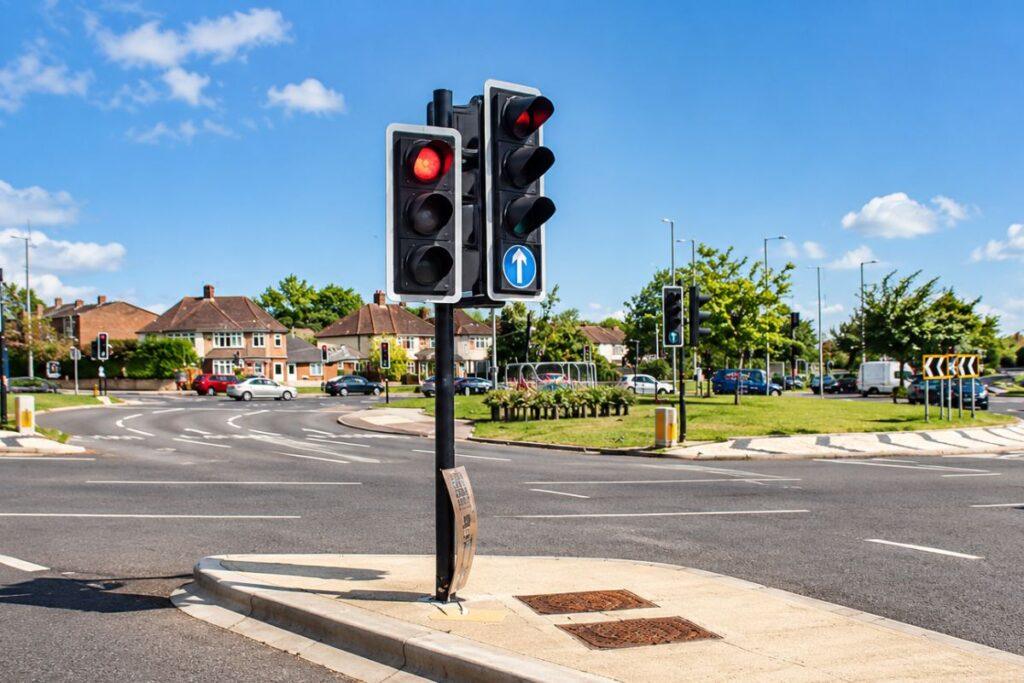
The traffic lamp-related rules on UK roads are mandatory legal regulations under The Highway Code that govern how drivers respond to red, amber, and green light signals at junctions to ensure road safety, prevent collisions, and control traffic flow.
Red means stop behind the line. Red and amber mean you should wait. Green means go if the way is clear. ‘Amber’ means ‘stop’, unless it’s unsafe to pull up. Running a red light in the UK costs £100 and three penalty points.
Britain’s junctions run on a simple rhythm, yet the small print catches drivers out daily. Knowing what each traffic lamp colour demands keeps your licence clean and your passengers safe. Here is the full picture, from the 1868 original to today’s sensor-driven kit.
- Red and amber together mean prepare to go. It does not mean you can go.
- Amber means stop, unless stopping would cause a collision.
- No part of your car may touch or cross the white stop line.
- Green never cancels your duty to give way to pedestrians already crossing.
- Amber runs for three seconds nationally. Red and amber run for two.
- When signals fail, nobody has priority.
What Is A Traffic Lamp?
A traffic lamp is a signalling device fitted at junctions, pedestrian crossings and level crossings to control traffic flow. A standard head shows three aspects: red on top, amber below, then green. Horizontal heads place red opposite the traffic flow.
Wikipedia states that the same devices are called ‘robots’ in South Africa, Zambia and Namibia and that the 1968 Vienna Convention set the international pattern.
The legal details are governed by the Traffic Signs Regulations and General Directions (TSRGD) 2016. Understanding these signals is vital for road safety: according to the Department for Transport (DfT), 58% of all reported road casualties in Great Britain occur at or within 20 metres of a junction. Obeying light sequences and drive carefully directly mitigates the primary hotspot for UK traffic collisions.
A Short British History
The first signals appeared in December 1868 on Parliament Square, outside the Houses of Parliament. Railway engineer John Peake Knight designed them to reduce the need for police officers on point duty.
A constable raised and lowered semaphore arms by day and worked a lever for gas-lit red and green lamps at night. The system exploded on 2 January 1869 and was taken down.
Progress then moved abroad. Lester Wire, a Salt Lake City policeman, built the first electric signal in 1912. William Potts created the first four-way, three-colour signal in Detroit in 1920, adding the amber caution aspect. Garrett Morgan patented a manual three-way design in 1923.
ALSO READ: What Are Ghost Registration Plates? Here’s Why Dodging Cameras With Them Is Not Worth It
How Traffic Lamps Work Today
Three parts do the job. Automate Systems describes the controller as the brains, holding the sequences for each time of day and location. Detectors spot cars arriving, entering turn lanes or stacking up. Signal heads display the result.
Two operating styles exist:
- Fixed period: Signals change on preset timings and cycle even when nothing is waiting. They suit predictable, slow traffic but waste green time on quiet side roads.
- Vehicle-triggered: Signals read demand and share green time within fixed minimum and maximum limits. Semi-triggered units react only to side streets. Fully triggered units react to every approach.
Detection comes from sensors above the head or induction loops set into the road. Loops rarely fail, yet they can miss motorcycles and bicycles on quiet approaches.
The UK Sequence Explained
The order is: Red → Red and amber → Green → Amber → Red.
| Signal | The Highway Code wording | In practice |
|---|---|---|
| Red | RED means ‘Stop’. Wait behind the stop line on the carriageway | Full stop. No creeping forward |
| Red and amber | RED AND AMBER also mean ‘Stop’. Do not pass through or start until GREEN shows | Select your gear and stay put |
| Green | ‘Green’ means you may go on if the way is clear. Take special care if you intend to turn left or right and give way to pedestrians who are crossing | Check your exit is clear first |
| Amber | ‘Amber’ means ‘stop’ at the stop line. You may go on only if the AMBER appears after you have crossed the stop line or are so close to it that to pull up might cause an accident | Brake in good time if you safely can |
| Flashing red | Alternating flashing red lights mean YOU MUST STOP | Level crossings, lifting bridges, fire stations |
Table Source: Data compiled from the UK Department for Transport (DVSA) – The Highway Code (Light Signals Controlling Traffic, Rule 175).
Flashing amber appears at pelican crossings. You may move off once nobody is crossing, but pedestrians keep priority. Evans Halshaw flags a common myth about traffic lights here: red and amber do not permit a slow roll over the line.
Where To Stop, And How To Turn
Where a stop line is painted, halt just before it. Where none exists, stop before the lamp itself.
A green filter arrow marks only a filter lane. Do not enter that lane unless you intend to go that way. You may proceed when the arrow or the full green shows. Give cyclists time and room to reach the correct lane.
Turning right, unless signs say otherwise: give a right-turn signal, position yourself just left of the middle of the road, leave room for others to pass on the left, keep your wheels straight, and then turn when traffic clears. If the lights change while you wait inside the junction, exit as soon as it is safe. Do not remain within the junction.
Box Junctions
Rule 174: Enter a box junction only if your exit road is clear. These carry criss-cross yellow lines. You must not enter until your exit road or lane is clear. You may enter and wait to turn right when only oncoming traffic, or other right-turning vehicles, stops you. At signalled roundabouts you must not enter the box unless you can cross it completely without stopping.
Pedestrians, Faults And Emergency Vehicles
A turning vehicle always gives way to pedestrians crossing the road it is turning into, even without a green walking figure. Give way to anything using a bus lane, cycle lane or tramway from either direction.
If a traffic lamp fails, treat the junction as unmarked. Nobody has priority, so give way sensibly and look in every direction. Blue-light emergency vehicles may pass through red signals, which is another reason to check both ways on green. You must obey any directions given by a police officer or another authorised person.
Fines And Penalties
Ignoring a red light incurs a fixed penalty of £100 and three penalty points, which remain on a driving licence for four years. According to Home Office policing data, police forces across England and Wales process over 67,000 signal compliance offences annually.
Despite strict enforcement, an RAC Report on Motoring survey revealed that 32% of UK drivers admit to routinely driving through amber lights when they had sufficient time to stop safely. Ignoring a Notice of Intended Prosecution escalates the penalty to six points and a maximum fine of £1,000.
Crossing on amber is not an offence, but poor judgement that causes a collision still counts against you. Many busy junctions carry cameras, and points push insurance premiums up for years.
Signal Timings
UK amber is fixed nationally at three seconds and red and amber at two, giving a minimum intergreen of five seconds before conflicting traffic gets green. Pedestrian crossing times are usually calculated against a walking speed of 1.0 metre per second.
ALSO READ: What Is Multi Car Insurance And How It Works? A Helpful Guide
FAQs
Q1. Is It Illegal To Cross On Amber In The UK?
No, but amber means stop. You may only continue if you have already crossed the line or braking would risk a collision.
Q2. Can I Be Fined For Stopping In A Box Junction?
Yes. Blocking a box junction can bring a penalty charge notice from the council, typically £70 to £130 depending on the area.
Q3. What Do Red And Amber Together Mean?
Get ready to move. You must not cross the stop line until the green shows.
Q4. Who Goes First When Traffic Lights Are Broken?
Nobody has priority. Treat it as an unmarked junction: give way to whoever arrives first and proceed slowly.
Q5. Do All Traffic Lights Have Cameras?
No. Cameras are fitted selectively to monitor flow, enforce signals and catch violations at busier junctions.
Q6. When Were Traffic Lights Invented In Britain?
December 1868, outside the Houses of Parliament in London, designed by railway engineer John Peake Knight.
Sources & References
- Wikipedia. (2026). History of traffic lights. In Wikipedia.
- Department for Transport. (2025, October 22). The Highway Code – Light signals controlling traffic. GOV.UK.
- Department for Transport. (2025, October 22). The Highway Code – Annex 5: Penalties. GOV.UK.
- Smithsonian Magazine. (2024, December 9). Chaotic traffic from horse‑drawn carriages inspired the world’s first traffic lights. Smithsonian History Correspondent.
- Legislation.gov.uk. (2016, April 22). The Traffic Signs Regulations and General Directions 2016. UK Statutory Instrument No. 362.
Disclaimer: This article is provided for general informational and educational purposes only and is not intended for promotional purposes. The information regarding traffic laws, penalties, and signals should be independently verified through official highway guidance, and readers should seek professional advice before acting on any content provided herein.