Picture a normal Tuesday evening. Kettle on. Email open. Someone’s forwarded you a link with a subject line that basically screams: “New House Tax Coming?”
That’s where the labour house value tax chatter lives right now. Not in neat policy papers. In group chats, solicitors’ inboxes, and those slightly tense kitchen conversations where someone says, “If they do that, what happens to us?”
Here’s the thing. The UK’s property tax setup is old. Council Tax still leans on 1991 values, which is honestly wild when you think about how much some areas have changed. And Stamp Duty Land Tax is the opposite problem: it hits you in one big whack when you move, which can freeze the market because people just can’t face the bill.
So when Labour talks about property tax reform, it lands with a thud. Not because everyone loves the current system, but because homes aren’t “assets” in people’s heads. They’re where the kids’ heights are on the doorframe.
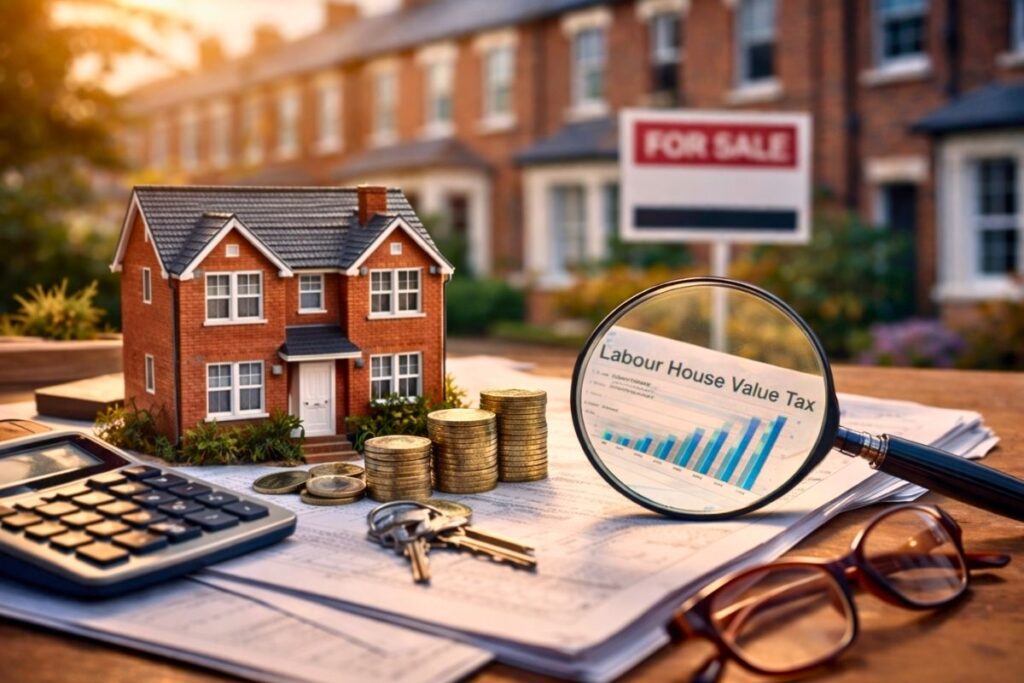
Right now, two ideas are getting mixed together in headlines. One is real and already announced: a high-value Council Tax surcharge on homes worth over £2 million. The other is broader: the “House Value Tax” concept, where you’d replace today’s messy mix with a more direct annual charge based on what a home is actually worth now. Those are related, but they’re not the same thing.
Let’s sort it out calmly.
Outdated Property Taxes Are Warping Housing Choices
Most people pay Council Tax and grumble once a year when the letter arrives. The key detail is the valuation base. In England and Scotland, Council Tax bands were set using property values from 1991.
The Institute for Fiscal Studies has been blunt about how hard this is to defend over time, because the winners and losers aren’t just about income; they’re about geography and luck. Two similar households can pay very different amounts simply because one town’s prices took off and the other didn’t.
Stamp duty then piles on a different kind of distortion. It’s a moving tax. You pay it when you buy. So it can discourage downsizing, moving for work, or shifting because your family’s changed.
The Joseph Rowntree Foundation has written about how property taxes shape the housing market and who gets a fair shot at moving.
That’s the backdrop. Outdated annual tax. Chunky one-off moving tax. And a housing market that’s already touchy.
ALSO READ: What is LBTT Calculator And How It Affects Property Costs In Scotland
High Value Council Tax Surcharge: Mansion Tax
The clearest, most specific policy in this space is the “mansion tax”-style surcharge, officially described as a High Value Council Tax Surcharge. HomeOwners Alliance sets out the bands and the basic mechanics in plain English.
The surcharge is described as applying to homes valued above £2 million, with annual amounts that rise by band.
Collyer Bristow, writing from a legal and private client angle, lists the same tiered charges and flags the big practical question: how values will be decided and how appeals will work.
One more detail matters because it’s easy to miss. Reporting in early January 2026 has suggested the Valuation Office Agency may use desktop-style valuations, rather than visiting homes, when identifying which properties cross the threshold. That has sparked worries about overvaluation and who ends up dragged into the net.
So yes, there’s a policy. And yes, it’s targeted at high-value homes. But it’s not the same thing as a full “House Value Tax” replacing everything.
ALSO READ: What Is an Indemnity Policy in Property Sales? A Complete Guide
Labour House Value Tax: From 1991 Bands to Real-Time Valuations
The broader “House Value Tax” idea is basically this: instead of Council Tax being based on 1991 bands, you’d charge an annual amount that tracks the home’s current value more proportionally.
Think of it like moving from an old set of shelves labelled A to H to a system that measures the thing in front of you today.
Advocates argue it could be fairer and less economically clunky than Stamp Duty, because it doesn’t punish moving in the same way.
The Financial Times has covered the wider debate about replacing Stamp Duty with an annual levy and the distributional arguments around it, especially who gets hit hardest and where.
Some property investor-focused commentary frames this as a shift from a one-off cost to an ongoing cost, which changes cash flow and could reshape landlord behaviour in expensive postcodes. It’s not a neutral change if you own multiple properties.
And that’s where the phrase labour house value tax keeps getting used, sometimes sloppily, to describe the whole bucket of reforms. People blend the surcharge and the bigger reform idea into one scary blob, which is an easy mistake to make.
Current Versus Proposed: The Quick Comparison
| Feature | Current System (Council Tax And Stamp Duty) | Proposed Direction (House Value Tax Style Reform) |
|---|---|---|
| Valuation Base | Council Tax bands tied to 1991 values | Annual charge linked to current market value |
| How You Pay | Council Tax yearly, Stamp Duty when you buy | Potentially one annual system, with Stamp Duty reduced or removed |
| What It Encourages | Staying put to avoid Stamp Duty | Moving is less “tax painful” |
| Likely Regional Effect | London and South East often benefit from old banding | London and South East more likely to pay more, Midlands and North may pay less |
| Practical Pain Point | Weird unfairness between similar homes | Revaluations, disputes, and administration |
| Band Threshold | Annual Surcharge (On top of Council Tax) |
|---|---|
| £2.0m – £2.5m | £2,500 |
| £2.5m – £3.5m | £3,500 |
| £3.5m – £5.0m | £5,000 |
| £5.0m+ | £7,500 |
Who Wins And Loses Under A True Value-Based Tax
This is where it gets spicy.
A proportional tax based on current values doesn’t care that someone bought in 1998 when the street was cheaper. It doesn’t care that wages haven’t kept up. It just looks at the asset value today.
That’s why critics keep bringing up “asset-rich, cash-poor” households, especially older owners in London. People who are not living a champagne life, but whose home price has ballooned. That’s also why the Financial Times coverage keeps circling back to older homeowners and regional concentration.
If you live in the North, the fear might be different. Not “I’ll be crushed,” but “Will this finally fix a system that’s been quietly unfair for years?” It cuts both ways.
And if you’re a landlord in a high-value area, a shift from Stamp Duty to an annual charge changes the maths. A one-off pain becomes a recurring bite. Some investors will absorb it. Some will raise rents if they can. Some will sell. Property investor analysis has been pretty open about that risk.
ALSO READ: What Is Working Tax Credit And How Do I Claim It? – A Complete Guide
Valuations And Appeals
Taxes don’t feel real until someone tells you what you owe.
The surcharge on homes above £2 million raises an awkward question: who decides your home’s value, with what method, and what happens if they get it wrong? Collyer Bristow points out the lack of detail around valuation routes and the practicalities of challenge.
The January 2026 reporting around desktop valuations has poured petrol on that concern. If the first time you hear your home “counts” is a letter saying “Pay up,” you can imagine the reaction.
If Labour ever goes wider and tries a full House Value Tax approach, those admin questions multiply. You’d need a valuation backbone people trust, plus a decent appeal process that doesn’t take two years and a minor breakdown.
Safety Rails And Political Trade-Offs
Even people who like reform usually accept you need safety rails. The usual ideas, which come up again and again in UK tax debates, are:
- Phasing. So bills don’t jump overnight.
- Caps on annual increases. So you can plan.
- Deferrals for low-income households, especially pensioners, where the tax is settled when the home is sold.
- Transitional relief for recent buyers who already paid Stamp Duty.
- None of that is “free money”. It just spreads the shock.
And yes, it can become politically messy. Because the moment you add exemptions, you add complexity again. That’s the tightrope.
ALSO READ: What Is A Deed Of Variation Property? Key Mistakes You Can Avoid
Frequently Asked Questions
Is Labour Bringing In A House Value Tax In 2026?
A full replacement of council tax and stamp duty with a single house value tax is still a debated direction, not a single confirmed nationwide switch. What has been clearly set out is the high value Council Tax surcharge concept for homes above £2 million, with details discussed by HomeOwners Alliance and legal commentators.
What Does The Mansion Tax Surcharge Actually Cost?
HomeOwners Alliance describes annual charges that rise by band, starting at £2,500 per year for properties just above £2 million and increasing for higher value bands.
Why Do People Keep Mentioning 1991?
Because Council Tax bands in England and Scotland are rooted in 1991 values, which creates long term unfairness as prices shift unevenly by region. The IFS-linked debate coverage lays out why many economists see this as hard to justify.
Would This Hit London Harder Than The North?
Most likely, yes, if the system becomes more proportional to current values. High-value areas would tend to pay more. That’s a core reason this debate gets heated fast.
Could People Challenge Their Home’s Valuation?
That’s one of the big open issues. Commentary has raised questions about how valuations will be reached and how appeals will work in practice, especially if desktop methods are used.
The Takeaway
The UK needs property tax reform. Most serious analysts agree on that much. The current setup is full of odd incentives and old assumptions.
But the minute you attach a yearly bill to today’s house prices, you’re not just changing tax. You’re changing the emotional contract people have with home ownership.
So if you’re reading headlines about the labour house value tax and feeling a bit twitchy, you’re not being dramatic. You’re reacting like a normal person who understands that “reform” often means “someone pays more”, and it might be you.
And that’s the real question, isn’t it?
If a letter landed tomorrow and your home was suddenly “worth” more on paper than it feels in real life, would you trust the number enough to pay it without arguing back?
Sources And References
- HomeOwners Alliance: The 2026/28 Tax Guide UK Property Tax Changes 2026: How The “Mansion Tax” Will Work.
- GOV.UK: High Value Council Tax Surcharge (Official) High Value Council Tax Surcharge – Fact Sheet
- Institute for Fiscal Studies (IFS): The Case for Reform CIOT/IFS Debate: Outdated Property Tax System Ripe for Reform
- Property Investors Network: The Investor Angle House Value Tax UK Explained – Impact on Property Owners
- St. James’s Place: Wealth and Regional Impact Mansion tax to hit homes worth £2 million or more
Disclaimer: This article is provided for informational purposes only and does not constitute legal, financial, or professional advice. It is not intended to promote or endorse any company, product, service, or investment. Readers should seek independent advice before making decisions based on the content of this article.