
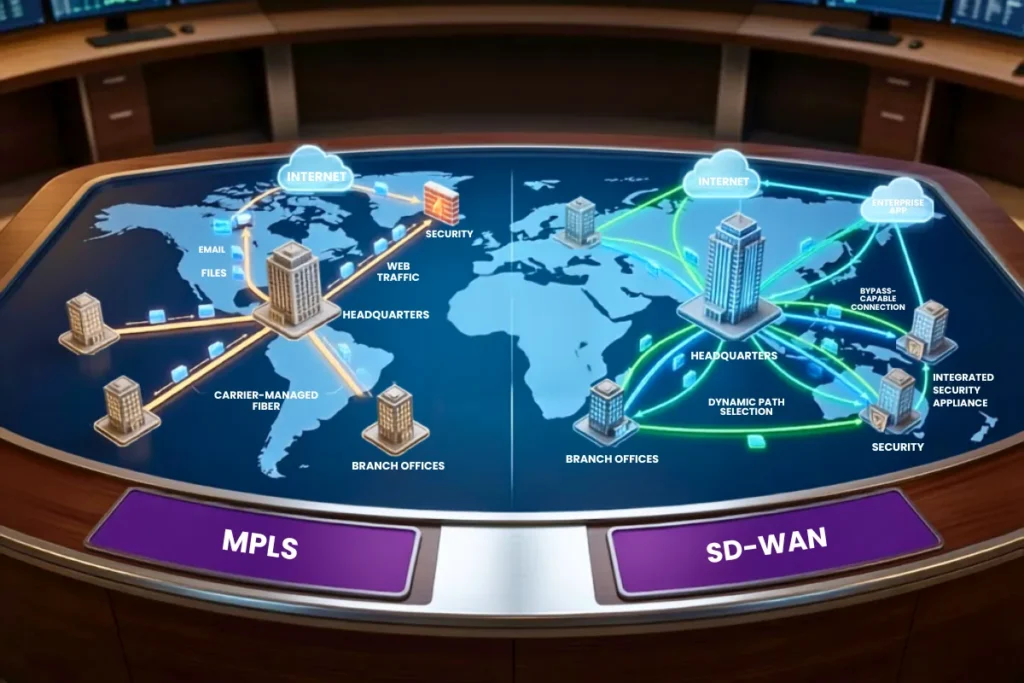
Multiprotocol Label Switching (MPLS) has been the enterprise-wide area networking workhorse for decades. MPLS is a dedicated, private & predictable network technology that has provided organisations with a reliable means to connect branch offices, data centres & headquarters in a way that offers guaranteed quality of service.
But that reliability was accompanied by a price — both fiscal and operational. The requirements on enterprise networks have changed dramatically, and as a result, organisations are looking to software-defined wide area networking (SD-WAN) to help reduce their reliance on costly MPLS circuits while maintaining performance and control.
To provide a clear picture of what each technology does, where they both fall short, and how they complement each other, you need to first understand how and why that transition happens and what it means for enterprise network strategy.
Cost Structure Of MPLS And Why It Becomes A Problem
MPLS networks run on a private, carrier-managed infrastructure. With label-based forwarding, traffic is sent over dedicated paths, which allows network teams granular control over the routing and prioritisation of different types of traffic. MPLS has usually been the gold standard for applications that require low latency, predictable performance, voice, video, and transaction processing systems, among them.
The problem is not performance. The problem is economics. Dedicated MPLS circuits remain significantly higher in price per Mbps compared to enterprise broadband and Dedicated Internet Access (DIA). According to benchmark data from TeleGeography, transitioning from an all-MPLS architecture to a hybrid or internet-based SD-WAN model delivers an average 30% to 50% reduction in total WAN Total Cost of Ownership (TCO).
Line-bearing MPLS circuits, including long-haul and international circuits, come with premium prices. MPLS contracts are often fixed via multi-year terms with very limited flexibility, which means organisations end up paying for committed capacity even if they do not consume it as well as being forced to remain inflexible to changing business needs.
Cloud computing has grown and put immense pressure on legacy designs as well. Routing all traffic back to headquarters through an MPLS network made architectural sense when the majority of enterprise applications ran in on-premises data centres.
Today, with over 80% of enterprise application workloads hosted in public cloud and SaaS platforms (Gartner), the traditional hub-and-spoke MPLS model forces traffic to hair-pin back to central locations. This adds unnecessary latency and wastes expensive MPLS bandwidth on traffic that could reach the internet far more efficiently through local breakout.
ALSO READ: How AI Simplifies Backup Management in Complex IT Infrastructures
What SD-WAN Does Differently
To comprehend how SD-WAN reduces MPLS dependency at an architectural level, one must appreciate the primary design principle that separates software-defined networking through WAN from previous generations of approaches: separating the control plane from the data plane. Gartner forecasts that over 70% of enterprise sites will utilise SD-WAN or SASE-based architectures to manage branch connectivity, marking a decisive shift away from legacy carrier-centric routing.
In a traditional WAN, like MPLS or router-based WAN, routing logic is built into each individual device. Configuration changes must be executed device-by-device and site-by-site — a slow, error-prone process that does not scale well in large distributed organisations. SD-WAN abstracts this control logic into an overarching management layer, meaning the network administrator sets policies once and applies them across the entire WAN from a single interface.
SD-WAN does something fundamentally different at the transport layer when it comes to connectivity. Instead of owning a single purpose-built circuit, SD-WAN aggregates multiple transport links into one pool of capacity, which can include MPLS, broadband internet, dedicated internet access (DIA), 4G/5G, or any combination thereof.
Traffic steering is done dynamically based on real-time performance measurements, application requirements, and policy rules. A critical voice call can route over the most reliable path available, while general web traffic utilises a less expensive broadband connection.
That dynamic, policy-driven traffic management is precisely what allows organisations to start replacing some of their MPLS capacity with lower-cost internet connections without suffering an all-or-nothing reduction in application performance.
ALSO READ: How Safe Is Internet Banking – What Everyone Needs to Know
The Migration Path: Hoisting Libraries Before Ditching Them
Reducing MPLS dependency for the majority of enterprises is an evolutionary, not revolutionary, process that relies on phased augmentation rather than mass replacement. Industry data from TeleGeography shows that approximately 65% of SD-WAN adopters retain a hybrid WAN model rather than abandoning MPLS entirely.
MPLS still has a place, primarily for long-haul international connections where internet performance varies widely, or where guaranteed SLAs are strictly required for latency-sensitive applications. SD-WAN allows enterprises to right-size their MPLS: utilising it only for circuits and applications where quality assurances are truly mandatory, and substituting lower-cost alternatives across the rest of the enterprise.
One excellent candidate for a hybrid approach is branch offices that historically required full MPLS connectivity for all traffic. With SD-WAN, branch users can access cloud applications directly over the internet, which improves performance by skipping backhauling through a central data centre. The existing MPLS circuit at that branch can be downsized or removed completely based on whether it carries application types that justify its price premium.
The analysis of where to draw these lines requires careful examination of application inventories, traffic patterns, and geographic factors. The SD-WAN and MPLS comparison that network architects must conduct is not simply a cost evaluation; it is a calculation of which traffic types are sensitive enough to performance variability that guaranteed MPLS quality justifies a 2x to 3x price premium per Mbps, and which can tolerate internet-based transport.
| Key Performance Metric | Legacy MPLS Circuit | Dedicated Internet Access (DIA) | Business Broadband + SD-WAN |
|---|---|---|---|
| Average Monthly Cost (100 Mbps) | ~$1,439 / month | ~$503 / month | ~$241 / month (incl. SD-WAN fee) |
| Deployment Lead Time | 60–90 days (8–12 weeks) | 30–45 days | 1–5 days (Zero-Touch Provisioning) |
| Bandwidth & Contract Flexibility | Rigid multi-year fixed commit | Scalable bandwidth on demand | Dynamic multi-link aggregation |
| Availability SLA | Strict carrier SLA (99.999%) | Standard enterprise SLA (99.9%) | Aggregated multi-transport uptime (99.99%) |
| Cloud Application Routing | Backhauled (Hair-pinned via HQ) | Direct internet breakout | Optimised local internet breakout |
| Primary Enterprise Deployment | Core datacentres & critical legacy workloads | Primary enterprise sites & HQ | Distributed branch offices & cloud-first sites |
Table Source: Benchmark metrics adapted from TeleGeography Enterprise WAN & SD-WAN Pricing Index Data.
Centralised Management And Operational Efficiency
One of the less visible benefits of SD-WAN is the operational improvement gained through centralised management. Conventional WAN environments relying on MPLS and legacy proprietary topologies require manual tuning at each location, plus extensive collaboration with carrier teams to modify routing or increase circuit bandwidth. This creates a significant layer of operational overhead for internal network teams and managed service providers alike.
SD-WAN consolidates management into a software layer, allowing network operations teams direct control over policy, routing, and monitoring from one interface. Strong IT operations also depend on secure business communication systems, especially for distributed teams managing enterprise infrastructure.
An IDC benchmark study revealed that adopting centralised SD-WAN orchestration yields an average 38% improvement in network management efficiency. Furthermore, deploying new branches no longer requires skilled engineers on-site. Using Zero-Touch Provisioning (ZTP), non-technical staff can simply plug in pre-configured appliances, slashing site turn-up times from typical carrier MPLS lead times of 8 to 12 weeks (60–90 days) down to just a few hours or days.
For companies with dozens or hundreds of distributed locations, this operational simplification delivers a measurable reduction in IT labour costs that grows over time, compounding the direct circuit savings achieved from reduced MPLS consumption.
Diverse Network Strategy: The Business Case For SD-WAN Adoption
Weighing the financial aspects of SD-WAN heavily depends on each organisation’s situation. Geography matters: the MPLS-to-broadband price differential varies enormously depending on the region, creating radically different economics for domestic networks compared to global enterprises reliant on international MPLS links. Current contract terms are important as well, as organisations with multi-year MPLS commitments may face early termination fees that impact short-term returns.
A structured approach to quantifying the opportunity begins with a full inventory of existing MPLS circuits, committed bandwidth, contract terms, and associated costs. Traffic analysis then identifies which circuits carry primarily cloud-bound or internet-bound traffic — the prime candidates for broadband substitution.
The enterprise SD-WAN business case must account for both transport savings and the costs of the SD-WAN overlay itself, including hardware, subscription licenses, and backup internet links. Modern subscription models help smooth out upfront capital expenditure (CapEx) into predictable operational expenditure (OpEx).
SD-WAN And Security Integration
Reducing MPLS dependency creates a critical security requirement that enterprise network teams must address head-on. Because an MPLS private network operates in isolation from the public internet, traffic traversing it has traditionally been treated as inherently trusted. Conversely, when SD-WAN introduces broadband internet or DIA as transport options, traffic travels over public infrastructure.
Modern SD-WAN platforms resolve this by establishing automated, end-to-end encrypted overlay tunnels (IPsec) across any transport underlay. Additionally, the industry is rapidly converging networking and security into single-vendor SASE (Secure Access Service Edge) platforms.
Gartner projects that 70% of new SD-WAN purchases will be integrated into unified SASE solutions, incorporating next-generation firewalls, Secure Web Gateways (SWG), and Zero Trust Network Access (ZTNA). This ensures local internet breakouts at branch offices remain secure without hair-pinning traffic back through central firewalls.
FAQs
Q1. Is SD-WAN An All-Or-Nothing Proposition When It Comes To MPLS?
Not at all. Research shows that around 65% of enterprise deployments use a hybrid WAN model. Organisations leverage SD-WAN to steer everyday cloud and internet traffic over cost-effective broadband links while retaining MPLS for latency-sensitive, mission-critical applications that require rigid SLAs. The exact ratio depends on an organisation’s specific application mix, geographic reach, and existing carrier contracts.
Q2. How Does SD-WAN Offer Performance Benefits For Cloud Applications?
Traditional MPLS backhauls all branch traffic to a central data centre or HQ before sending it to the cloud, adding latency and consuming high-cost bandwidth. Given that over 80% of enterprise traffic is now destined for cloud platforms, SD-WAN enables direct local internet breakout at branch locations. Traffic routes dynamically over the fastest available link directly to SaaS and IaaS providers, improving response times while dramatically reducing MPLS bandwidth consumption.
Q3. What Security Considerations Arise When Moving From MPLS To SD-WAN?
Because internet-based SD-WAN transports data across public networks rather than private MPLS lines, robust encryption is required. Modern SD-WAN solves this by placing all traffic inside encrypted IPsec tunnels. Furthermore, with 70% of new deployments transitioning to SASE architectures, platforms integrate deep packet inspection, cloud firewalling, and Zero Trust access directly into the WAN edge, ensuring local breakouts do not expose the network to unmonitored threats.
Sources & References
- ITG Group. (2026, April). SD‑WAN vs MPLS: 2026 cost & use‑case comparison. ITG Group Research.
- TechDogs. (2026, January). Top 20 networking technology statistics to know in 2026. TechDogs – Networking Solutions.
- IDC MarketScape. (2025, December). Asia/Pacific managed SD‑WAN/SASE services 2025–2026 vendor assessment. IDC Research.
- Grgurević, I., Barišić, G., & Stančić, A. (2021). Analysis of MPLS and SD‑WAN network performances using GNS3. Faculty of Transport and Traffic Sciences, University of Zagreb. Springer Nature Switzerland.
- Wikipedia. (2021). Multiprotocol Label Switching. In Wikipedia.
Disclaimer: This article is published strictly for informational and educational purposes only. The information provided herein does not constitute professional technical or commercial advice, nor is it intended for marketing or promotional purposes. Readers are advised to evaluate their specific infrastructure requirements independently before implementing any technology solutions.