
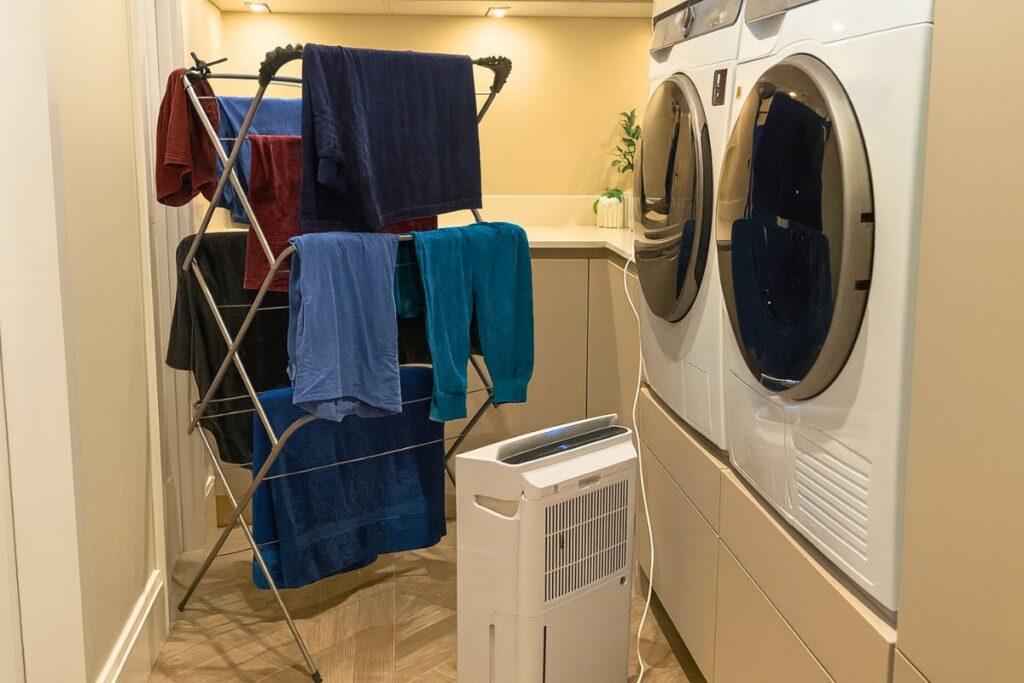
Winter’s here. It is taking three days for your washing to dry indoors. The radiators are already running full tilt. Tumble dryers are so expensive to operate. So can you use a dehumidifier for drying clothes?
Yeah, you can. Works surprisingly well too.
What Actually Happens
The moisture is released into the air as wet clothes dry. It’s why your windows are steamed up when you’re drying washing indoors. The air gets saturated with water, and your clothes are damp for days.
A dehumidifier for drying clothes sucks that wetness away. Keeps the air dry, so your clothes can go on releasing water rather than staying there all damp.
Which? tested this. Two identical wash loads – one with a dehumidifier and one without. The dehumidifier reduced the drying time by nearly half. Drew 2 litres (approximately) of water out of the air that would have otherwise been condensation on your walls or windows.
Running Costs
This is where things get interesting. Martin Lewis bangs on about dehumidifiers because they’re way cheaper than tumble dryers.
A tumble dryer consumes 4.7–5.4 kWh per cycle. At today’s prices, that comes to the equivalent of about £1.27 to £1.46 per load. And if your clothes are not dry, you’re running it again.
Most dehumidifiers tend to cost around 7p an hour. You leave it on for 12 hours to dry a full load and you’re talking 84p to £1.50 tops. Some of the newer ones can be as little as a penny an hour.
Trade-off? Takes longer. The tumble dry is done in an hour or two. A dehumidifier requires 4 to 12 hours, depending on the dampness of your garments. But let’s face it, if you are drying overnight or while you’re at work, who cares?
How To Use Dehumidifier For Drying Clothes
Right, there’s a proper way to do this.
Give your clothes an extra spin in the washing machine first. Most machines have a 1400rpm or 1600rpm spin – use it. The drier they are when you hang them up, the less work the dehumidifier does.
Hang clothes on an airer. Not over radiators – causes condensation and stops your heating from working properly. Plus your clothes will smell weird.
Place the dehumidifier close to the airer but not touching. Most need to be at least 20 cm away from walls anyway.
If your machine has a laundry mode, use it. These usually just run at full power for 6 to 10 hours. Some smarter ones adjust automatically as clothes dry.
No laundry mode? Set target humidity to 30-40% and let it run.
Close the door to the room. Stops moisture spreading through your house. A smaller closed space dries faster than an open-plan one.
ALSO READ: How To Clean A Washing Machine: Smart And Easy Cleaning Methods
What Size Dehumidifier For Drying Clothes?
A 10-litre capacity suffices for small rooms or relatively light loads. That’s how much water it can extract from the air per day, not how big its tank is.
For larger spaces or full loads, invest in a dehumidifier for drying clothes of 20 L or above. These work faster. The downside is they’re heavier and bulkier.
The sweet spot for most people is 12-16 litres. Big for a full load, small enough to tote to a couch or table as needed.
Think about your space too. A tiny bathroom or utility room won’t fit a massive 20-litre unit. Spare bedroom or large kitchen? Go bigger.
Features That Matter
Not all dehumidifiers are the same. Here’s what actually matters:
Extraction rate beats tank size. A machine pulling 20 litres per day dries clothes faster than one managing 10 litres.
Continuous drainage is brilliant for long runs. The majority of them have a tank you will need to empty when full. Hook up a hose to drain into a sink and you can run the machine all night with no stopping.
Timer settings allow you to program it to turn off after 6, 12 or 24 hours. Convenient if you’re drying laundry overnight.
Auto shut-off prevents the machine from overflowing when the water tank is full. The noise level is important if you plan to use this in a bedroom or living room. Look for models under 40 dB. Anything louder gets annoying.
Real Experience
Ideal Home tested the SmartAir Dry Zone – it dried a full load in just 4 hours using smart laundry mode. Started at 60% humidity, dropped to 48% in 6 hours. Costs about 11p per hour.
The Russell Hobbs 20L has smart and laundry-drying modes. People loved how easy it was and how fast clothes dried.
The big thing everyone mentions is that clothes dried with a dehumidifier don’t smell musty like they sometimes do when drying indoors. The machine keeps the air dry so there’s no dampness for bacteria to grow. Clothes come out fresh.
Tumble Dryers Vs Dehumidifiers
Tumble dryers are faster. Need your jeans dry in an hour? Tumble dryer wins.
But they’re expensive to run. Rough on clothes too – ever noticed your t-shirts shrinking after a few tumble cycles? Can’t handle delicate fabrics either. Those “do not tumble dry” labels exist for a reason.
Dehumidifiers are gentler. Just speeds up natural drying. Clothes don’t shrink, colours don’t fade as fast, and delicate fabrics stay intact.
Plus, you can use a dehumidifier year-round. Winter for drying clothes. Summer is to stop your house getting damp and musty. A tumble dryer’s just a tumble dryer.
Small Flats
This is where dehumidifiers really shine. Live in a flat with no garden? Limited space? Drying clothes is a nightmare. Radiators covered in washing, place smells damp, condensation everywhere.
A compact 10-12 litre dehumidifier sorts it. Stick it in your bathroom or bedroom with an airer, close the door, and leave it running. Clothes dry faster, the room stays fresh, and radiators work properly.
Running costs are low enough for tight budgets. You’ll save money on mould treatments and window repairs from condensation damage too.
Problems To Watch For
Tanks fill up quickly with a full load of wet washing. If you’re not home to empty it, machine stops and the clothes stay damp.
Continuous drainage fixes this but you need a sink nearby. Not always practical in a bedroom or living room.
Some cheaper models are noisy. Properly annoying if you’re trying to sleep or watch telly. Check the decibel rating before buying.
Dehumidifiers aren’t free to run; they cost money. They’re cheaper than tumble dryers, but if you’re drying clothes every day, the costs add up.
Worth It?
If you dry clothes indoors regularly and don’t have a tumble dryer, yes. Worth every penny.
Running costs are reasonable. Works faster than air drying alone. Clothes don’t smell damp. Stops moisture from causing mould in your house.
Got a tumble dryer already? A dehumidifier for drying clothes still makes sense for delicate items or stuff you can’t tumble dry. A gentler option that saves wear on your clothes.
For flats or homes with poor ventilation, it’s basically essential. Winter means wet washing hanging around for days otherwise.
The best models cost £150 to £250. Not cheap but they last for years and save money compared to constantly running a tumble dryer.
Martin Lewis reckons they’re one of the best purchases for reducing household running costs. Hard to argue with that.
Disclaimer: This article is provided for informational purposes only. While reasonable efforts have been made to ensure the accuracy and reliability of the information presented, no guarantee is made regarding its completeness, accuracy, or timeliness. The content does not constitute any specialised advice and should not be relied upon as such. Readers are encouraged to conduct their own research and consult qualified professionals before making any decisions based on the information contained in this article.




I was recommended this blog by my cousin. I am not sure whether this post is written by him as no one else know such details about my trouble. You are amazing! Thanks!
I appreciate the clarity and depth; it really helped me understand the topic better.
The article is very useful and relatable.