
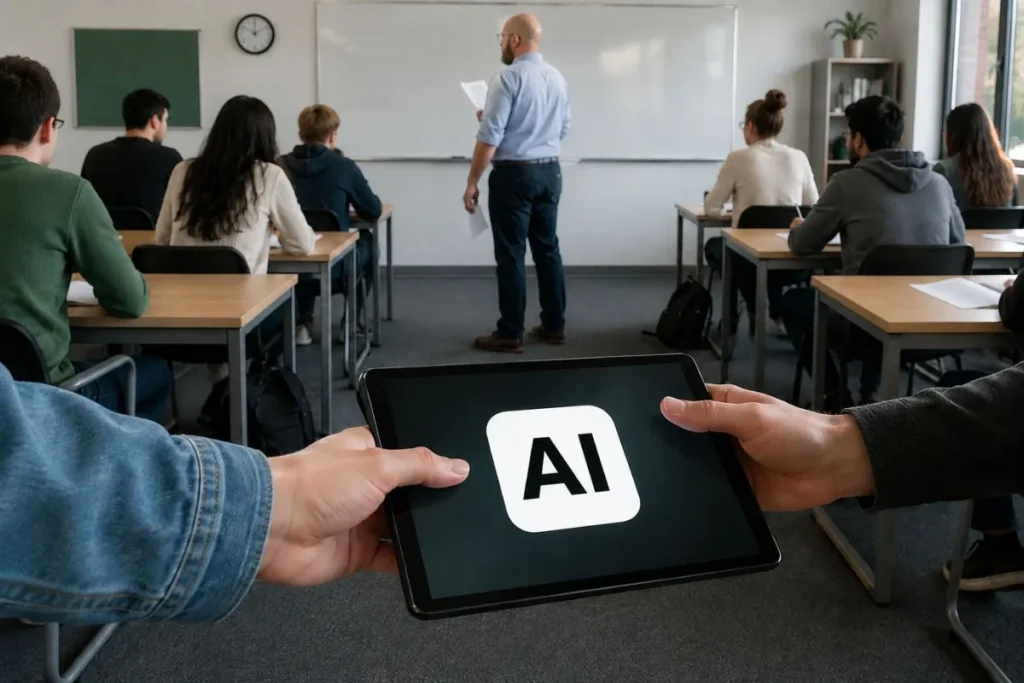
More than 2,000 students at Russell Group universities were punished for AI cheating related case last year. Most experts think that’s only the visible part of the problem.
A student submits a flawless essay at 2:13am. Perfect structure, clean references, confident arguments, the kind of work that usually takes days.
The lecturer reads it once and immediately knows something feels off. The problem is proving it.
That scene is now playing out across Britain’s top universities at a scale that would have sounded absurd two years ago. According to recent reporting, more than 2,000 undergraduates at Russell Group universities were penalised for Artificial Intelligence-related cheating during the 2024–25 academic year — nearly triple the previous year’s figure.
And those are just the cases universities could actually prove.
Universities Are Losing The Detection Race
The uncomfortable truth sitting underneath this entire debate is simple: AI-generated work has become extremely hard to catch.
Old-school plagiarism software was built to compare copied text against existing sources. Generative AI doesn’t copy in the same way. It creates fresh wording every time, which means the usual detection systems often miss it completely.
A widely discussed study from the University of Reading found that AI-generated exam submissions went undetected in 94% of cases — and regularly scored higher than real student work. That single statistic has become nightmare fuel for universities trying to protect academic standards.
It also explains why many academics believe official misconduct numbers barely scratch the surface.
Higher education is colliding with the same AI disruption already reshaping media, software, and office work. Universities just happen to have a very public accountability problem attached to it.
Degrees still rely on trust. Employers trust universities. Universities trust students. Students trust the system is fair. AI muddies all three at once.
ALSO READ: IGCSE Physics Study: Essential Advice For UK Students
The Grey Area Nobody Wants To Define
The debate becomes messy because not every student using AI sees themselves as cheating.
That’s partly because universities themselves still can’t agree on the rules.
One lecturer might allow ChatGPT for brainstorming. Another might ban it entirely. Some departments permit grammar refinement but prohibit generated text. Others require disclosure forms. Many students are navigating wildly inconsistent expectations across different modules in the same degree.
And realistically, modern students already use digital assistance everywhere else. Spellcheck, Grammarly, translation tools, Google, online tutoring platforms. AI doesn’t always feel like a radical leap from those systems — especially to students raised alongside them.
That doesn’t make misuse acceptable. But it explains why the line keeps getting blurred.
A recent survey highlighted by Stanford Graduate School of Education found growing concern among educators that students increasingly see generative AI as part of the normal workflow rather than an exceptional shortcut.
And honestly, universities helped create this mindset themselves. Higher education has spent years rewarding output over process. Fast results. Clean formatting. Constant productivity. AI simply industrialised it.
ALSO READ: School Leavers in the UK: How Traditions Have Changed Over the Last Decade
The Pressure Cooker Behind The Cheating Spike
Not every AI cheating case comes from laziness.
Some come from panic.
Tuition fees remain brutal. Competition for graduate jobs is intense. International students face enormous financial pressure. Many undergraduates are juggling part-time work alongside full course loads. Add rising living costs and the temptation becomes obvious.
A chatbot never sleeps. Never judges. Never gets impatient. It produces an answer instantly.
That matters more than universities sometimes want to admit.
There’s also a growing ecosystem around academic support that sits in a complicated middle ground. Platforms like Expertsmind offer homework help and tutoring support that many students use legitimately. Others increasingly look for shortcuts rather than support. The line between assistance and substitution keeps getting thinner as AI tools become embedded inside these services and workflows.
Ironically, some educators now argue the safer long-term solution may involve more human teaching, not less. Services like Expertsmind’s live tutoring network at least centre interaction, explanation, and guided learning instead of automated output generation.
Because the real danger isn’t students using AI occasionally. It’s students quietly losing confidence in their own thinking altogether.
Universities Are Redesigning Assessment In Real Time
The essay may no longer be king.
That’s the conclusion many institutions are slowly arriving at, even if few want to say it too loudly.
Universities are increasingly experimenting with oral exams, live presentations, in-class writing, reflective assessments, and staged coursework designed to show a student’s thinking process rather than just the polished final result.
That shift is expensive. It requires more staff time and smaller assessment windows. But the alternative is continuing to pretend that unsupervised take-home essays still reliably measure independent work in the ChatGPT era.
Some universities are already taking a tougher stance publicly. Reports covered by Inside Higher Ed suggest institutions are becoming increasingly concerned that unchecked AI misuse could damage the credibility of entire degree systems.
Meanwhile, investigations into the wider academic integrity crisis — including reporting from Editorialge — point to a growing fear inside universities that policy changes are lagging far behind student behaviour.
And that lag matters.
Technology evolves weekly. University bureaucracy evolves roughly once every committee meeting.
ALSO READ: Is UK and Great Britain the Same? Many Get It Wrong
This Isn’t Really A Story About AI Cheating
That’s the part many universities still haven’t fully understood.
AI cheating is partly a misconduct problem. But it’s also a warning sign that higher education is entering a completely different era of learning, assessment, and intellectual value.
If a chatbot can produce a convincing university essay in seconds, the problem may not just be the chatbot. It may be the assignment itself.
The uncomfortable question sitting underneath this entire crisis is whether universities are still testing genuine understanding — or simply testing who can package information most convincingly.
For decades, polished written work was treated as evidence of intelligence. AI has broken that assumption almost overnight.
Now universities have to decide what human learning actually looks like when machines can imitate it so well.
Sources & References
- University of Reading. (2025, December). AI‑generated exam submissions: Detection challenges and assessment outcomes. University of Reading Research Report.
- Stanford Graduate School of Education. (2025, October). Educator perspectives on generative AI in student work. Stanford GSE Publications.
- Inside Higher Ed. (2025, September). Universities redesign assessment to combat AI misuse.
Disclaimer: This article is provided solely for informational and educational purposes and should not be interpreted as professional, legal, academic, or institutional advice. The content does not promote or endorse any individual, organisation, platform, or service mentioned within the article. Readers are encouraged to independently verify information and consult qualified professionals where appropriate. The publisher and author shall not be held responsible for any decisions or actions taken based on the information presented in this article.