When Hackney Council unveiled the Future Shoreditch Area Action Plan on 3 March 2026, it quietly confirmed something many people had already noticed. Anyone working in Shoreditch had been watching these building changes for years. In fact, the transformation had been unfolding for well over two decades. The document simply put that long-running story into official planning policy.
The Shoreditch Transformation, Formalised
The plan identifies 15 opportunity sites across Shoreditch. Together, they could deliver around 500 new homes. They also include roughly 200,000 square metres of office floorspace. Another 15,600 square metres is planned for retail and community use. Oddly enough, the plan also estimates as many as 11,000 new jobs by 2040. On top of that, 28 separate projects focus on improving streets, public spaces and green areas. Several schemes are already moving through the planning process. These include the Shoreditch Works mixed-use development. The refurbishment of the Grade II-listed Philip Webb Terraces is also progressing.
What makes the Future Shoreditch plan interesting isn’t only its scale. That’s impressive, of course. The bigger story is that official planning has finally caught up with reality. The area has been changing naturally for more than twenty-five years. Now that evolution has been formally recognised.
Shoreditch was once one of East London’s most overlooked industrial districts. Affordable rents helped attract early businesses. So did the many vacant warehouses. Over time, things started to shift. By the early 2010s, the area had become London’s best-known technology cluster. Creative companies arrived too. Design studios followed. Hospitality businesses soon joined them. Today, Shoreditch stands as one of London’s most established commercial neighbourhoods. Much of its success came from adapting historic industrial buildings. It wasn’t driven by widespread demolition or complete redevelopment, and that’s pretty remarkable when you think about it.
The story of Shoreditch has been told many times. Most people know the headlines. What receives far less attention is something equally interesting. Similar patterns are now appearing across several parts of London. The changes look different from place to place, yet the overall direction feels surprisingly familiar.
ALSO READ: How to Design a Contemporary Home in the UK | A Practical Home Design Guide
The London Building Transformation Pattern
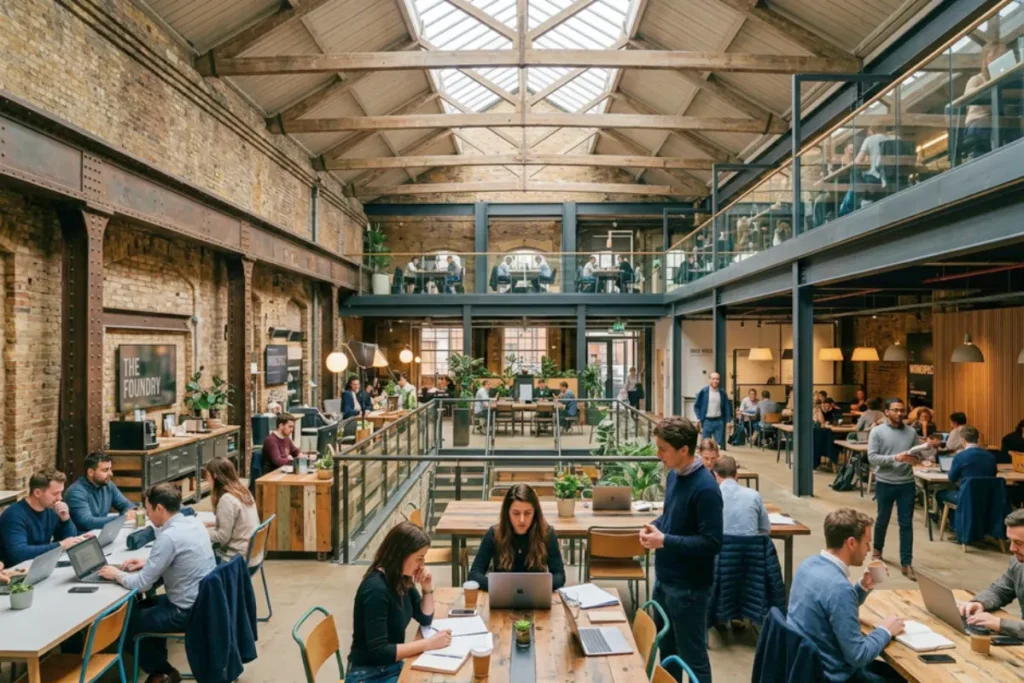
Shoreditch showed that London’s most distinctive workplaces do not always begin as brand-new developments. More often, they start as existing buildings with character. Those buildings are carefully adapted. They are refreshed for modern businesses while keeping much of what made them special in the first place.
The same pattern appears across the capital. An underused building sits in a well-connected location. Then investment arrives. Usually, a specialist workspace operator or developer takes the lead. Original industrial features stay wherever possible. Interiors are updated for today’s businesses. New companies move in. Local cafés, shops and services gradually follow. Bit by bit, the surrounding neighbourhood begins to change. It rarely happens overnight, but the momentum builds.
You can see versions of this process in Hackney Wick, Peckham, Bermondsey, Walthamstow and Tottenham. Other parts of London tell a similar story. King’s Cross, Nine Elms and the Royal Docks have all experienced significant change. Their regeneration has often been larger in scale. Even so, the underlying idea stays much the same. Every area has developed in its own way. Yet adapting existing buildings has become an increasingly important part of London’s commercial growth. That trend shows little sign of slowing.
The Role Of Specialist Workspace Operators
Much of this transformation has been shaped by specialist workspace operators. They focus on commercial buildings that others may overlook. Instead of relying only on major landmark developments, many concentrate on Shoreditch locations with strong transport links. They also look for buildings that still have distinctive architectural character. The goal is simple. Preserve what makes those spaces unique while preparing them for modern business use.
Purpose Group is one example of this approach. It sits alongside a growing number of independent workspace operators across London. These organisations specialise in giving older commercial buildings a new purpose. Their work reflects a broader move toward flexible workspaces. It also highlights the continued value of reusing existing buildings instead of replacing them. That’s becoming an increasingly important part of the city’s commercial landscape.
As Varsha Yadav, Head of Marketing at Purpose Group, explains:
“We look for buildings with good bones in places that are genuinely well connected. The aim is to retain what makes those buildings distinctive while creating workspaces that meet the needs of modern businesses.”
Companies may work in different ways. Still, many share the same core idea. They want to extend the life of existing buildings. At the same time, they adapt those spaces to match changing ways of working. It’s a practical approach, and honestly, it makes a lot of sense as workplaces continue to evolve.
ALSO READ: Minimalist Desk Setup Ideas: How Ryan London Brings Warmth to Technology
What This Kind Of Transformation Delivers
The value of these projects reaches far beyond the buildings themselves. That’s really where the bigger picture begins.
Refurbished commercial properties create valuable workspace for growing businesses. Many companies simply don’t need premium office space. Others can’t justify the high costs. Professional service firms, technology companies, healthcare providers, and creative businesses often prefer something different. They look for flexibility. They want easy access. They also appreciate workspaces with character. Let’s be real, those features can matter more than a traditional corporate office.
These buildings also bring energy to local neighbourhoods. Occupied workspaces attract more people every day. That creates demand for cafés, restaurants, independent retailers, and nearby services. Bit by bit, the area becomes more active. It develops the layered urban character that makes many of London’s best districts feel unique. Oddly enough, even small changes can have a lasting impact.
Another major benefit is preserving London’s architectural heritage. Historic commercial buildings don’t have to sit empty. They also don’t need to disappear completely. Adaptive reuse gives them a fresh purpose. It keeps them useful while protecting much of their original character. That balance is pretty impressive.
There is an environmental advantage too. Keeping existing buildings reduces the need for demolition. It also limits new construction. That helps lower embodied carbon. As a result, adaptive reuse has become an important part of London‘s wider sustainability goals. It’s not the whole answer, of course, but it certainly helps.
Beyond Shoreditch: Where It’s Happening Now
The Future Shoreditch Area Action Plan formalises a process that has already reshaped one of London’s best-known creative districts. Still, the more interesting question lies elsewhere. Which parts of London are quietly following the same path today? Chances are, more places are changing than most people realise.
Tottenham’s industrial areas have attracted increasing investment over the past decade. Much of it has focused on converting older workspaces. Wider regeneration projects have supported that progress. Hayes has also changed over time. Better transport connections helped. So did the regeneration of the Old Vinyl Factory. Borough, Southwark, Aldgate, and King’s Cross continue to show what is possible. Older commercial buildings can support a changing mix of businesses. They also strengthen the identity of their local neighbourhoods. It’s a combination that works surprisingly well.
These changes often become visible before official planning documents mention them. That’s usually how regeneration works. Individual building projects appear first. Small investments follow over time. Then, years later, the wider transformation becomes clear. Looking back, it almost seems obvious.
ALSO READ: How to Invest in Commercial Real Estate: A Proper Guide for Beginners
The London Workspace Story Worth Paying Attention To
Conversations about London’s office market often focus on major developments. They highlight headline deals and prestigious business districts. Yet another story has been unfolding. It’s quieter, sure, but arguably more influential. It has changed how many people work across the capital.
Adaptive reuse has reshaped neighbourhoods across London. It has supported business growth. It has also protected parts of the city’s architectural heritage that could easily have been lost. Shoreditch remains the best-known example. Even so, it is far from the only success story. Not even close.
London will keep evolving. That’s inevitable. Many of its most interesting workspaces will probably come from existing buildings. They won’t always come from brand-new developments. Instead, thoughtful reinvention will continue to breathe new life into familiar places. Many of these buildings have stood for decades. They still have plenty to offer. Their ongoing transformation will influence where businesses choose to settle. It will also shape how London’s neighbourhoods grow in the years ahead. And honestly, that’s a story worth watching.
Sources & References
- Hackney Council. (2026, March 3). Future Shoreditch Area Action Plan. Hackney Council Planning Policy.
- Property Week. (2026, March). Hackney unveils Future Shoreditch plan: 500 homes and 200,000 sq m of office space. Property Week News.
- The Guardian. (2026, March). Shoreditch transformation formalised: Adaptive reuse and London’s creative clusters. The Guardian London.
- Estates Gazette. (2025, December). London’s adaptive reuse trend: Shoreditch, Tottenham, and beyond. Estates Gazette Features.
- Purpose Group. (2025, November). Flexible workspaces and adaptive reuse in East London. Purpose Group Insights.
Disclaimer: This article is provided solely for informational and educational purposes. It is not intended to promote, endorse, or advertise any individual, company, product, or service. Readers should verify information through official sources before making any decisions based on the content presented. The publisher and author accept no responsibility for any actions taken based on this information.