
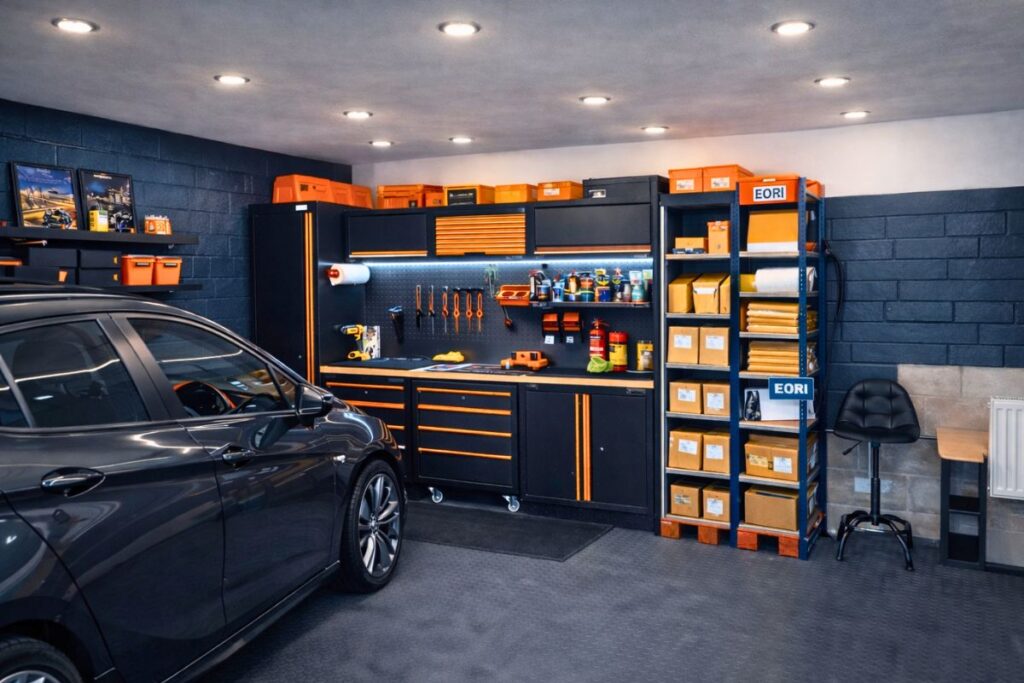
The hum of a delivery van at 7:00 AM used to be an annoyance. Now, for thousands of homeowners across Britain, it’s the sound of money. Since the “E-commerce explosion” of the early 2020s, the humble British garage has undergone a quiet, high-tech revolution. We aren’t talking about storing old paint tins and a rusty bike anymore. We’re talking about high-density racking, AI-managed inventory, and thermal membranes.
How to Set Up a Micro-Warehouse in Your UK Garage
In my fifteen years of advising small businesses on logistics, I’ve seen everything from spare bedrooms packed with bubble wrap to fully automated double garages that look like a miniature Amazon hub. But here’s the thing: in 2026, the rules have changed. If you’re planning to flip your garage into a professional fulfillment centre this year, you’re walking into a new world of business rates, digital customs, and “smart” automation.
Look, I’m going to be honest with you. Most people get this wrong. They jump straight into buying shelves without checking the council’s “Change of Use” rules or the 2026 tax revaluations. So, let’s sit down and walk through exactly how you turn that cold, concrete box into a logistics powerhouse that actually makes sense (and stays legal).
The Legal Groundwork: Don’t Let The Council Shut You Down
First things first. You can’t just start running a commercial hub from your driveway and expect the neighbours not to notice.
Planning Permission And “Change Of Use”
Most UK garages are legally designated for “residential storage” or parking. Now, if you’re just storing a few boxes for an eBay shop, you’re probably fine. But the second you start receiving daily pallet deliveries or have staff coming in, you’ve crossed a line.
According to the latest Planning Portal guidelines for 2026, you generally don’t need full planning permission if the business use remains “incidental” to the house. However, if your “Micro-Warehouse” in a UK Garage becomes the primary use of the property, or if it creates a “nuisance” (noise, traffic, fumes), you’ll need a Change of Use application.
The crazy part? In 2026, councils are using AI-equipped “street-view” mapping to spot unauthorised business activity. Don’t risk a retrospective enforcement notice. If in doubt, apply for a Lawful Development Certificate.
The 2026 Business Rates Revaluation
This is the big one that’s catching everyone out this year. On 1 April 2026, the Valuation Office Agency (VOA) implemented a massive revaluation of commercial property.
The good news? Most garage-based setups will still qualify for Small Business Rate Relief. As noted in the GOV.UK 2026 Business Rates Guidance, if your “warehouse” space has a rateable value of £12,000 or less and it’s your only business property, you likely won’t pay a penny in business rates.
But listen, you must report the change. If you don’t, and you get audited later, the backdated bills can be enough to sink a small business.

Tech Trends: The “Smart” Garage Setup For 2026
If you want to compete this year, you need to stop using clipboards and Sharpies. The “Internet of Warehouse Things” (IoWT) has finally become affordable for the little guy.
RFID And Digital Inventory
There was a time when you could mention RFID (radio frequency identification) and it was only for the big boys like DHL. Not anymore. By 2026, you’ll be able to purchase “plug-and-play” RFID kits that directly sync to your smartphone.
You don’t have to scan every single barcode; you just walk by a shelf with your phone out and the system will update your stock levels automatically. Zebra’s 2026 Tech Outlook highlights that small-scale RFID adoption has cut “shrinkage” (lost stock) by nearly 30% for micro-sellers.
Climate Control And Insulation
Garages are notoriously damp. If you’re storing electronics, fashion, or anything organic, the typical British winter will ruin your stock in weeks.
In my opinion, the very best thing you can do is to invest in some Damp Proof Membrane (DPM) and insulated plasterboard. For 2026, it’s cool-roof membranes – these keep the summer heat out and trap the heat in the winter; your “warehouse” will sit at an ambient 18°C all year round without doubling your power bill.
Logistics: The 2026 Courier War
Your business lives and dies by its exit strategy. Shipping rates in the UK have been volatile lately, but 2026 has brought some serious competition to the table.
| Courier | 2026 Service Highlight | Typical Starting Rate (Up To 2kg) |
|---|---|---|
| Royal Mail | 7-day delivery & 24/48 Tracked | ~£3.49 |
| Evri | Largest ParcelShop/Locker network | ~£3.29 |
| DPD UK | AI-driven “Predict” 1-hour windows | ~£5.99 |
| InPost | 24/7 automated locker drop-offs | Volume-based |
Honestly, the “Predict” service from DPD is still the gold standard if you’re selling high-value items. But for high-volume, low-cost goods? InPost’s locker network, which expanded to over 19,000 locations by early 2026, is a lifesaver for people who don’t want to wait around for a van pick-up.
Insurance: The “Home Policy” Trap
I cannot stress this enough: your home insurance does not cover your business.
If a fire starts because of a faulty lithium battery in your stock and you only have a standard residential policy, the insurer will walk away. You need a dedicated Commercial Combined Policy.
When I spoke with a broker at Bionic recently, they pointed out that in 2026, “hybrid” policies are now available. These cover the building as a residence but include a rider for Product Liability and Stock-in-Transit. Expect to pay about £1.20 to £2.00 a day for decent cover. It’s the price of a cheap coffee, and it protects your entire livelihood.
The Reality Check
Building a “Micro-Warehouse” in a UK Garage isn’t a “get rich quick” scheme. It’s a serious logistics project that requires a bit of grit and a lot of planning. You’re going to deal with freezing cold mornings, stubborn label printers, and the occasional delivery driver who can’t find your house.
But when you see that first batch of 50 orders organised on professional AMR-compatible shelving and ready for pick-up, the feeling is unbeatable. You’ve turned an underused space into a high-efficiency engine.
Anyway, the coffee’s getting cold and I’ve got a pallet of stock arriving in twenty minutes. Are you going to keep using your garage for junk, or are you ready to actually build something?
Just remember—get that EORI number sorted first. Trust me on that one.
ALSO READ: Labour House Value Tax: Why This Idea Won’t Leave Your Mortgage Broker Alone
FAQs
Q1. Do I Need An EORI Number If I’m Just A Small Garage Business?
Yes. If you are bringing in stock to your garage from overseas (including the EU), then you should be registered with an Economic Operator Registration and Identification (EORI) number. Customs will turn away any shipment without one, as the 2026 digital border upgrades were introduced.
Q2. Can I Store “Hazardous” Goods In My Garage?
Think twice. Storage of aerosols, chemicals or large numbers of lithium-ion batteries require a Fire Risk Assessment. If you live in a terraced or semi-detached house, your neighbours—and the fire service—might have something to say about that.
Q3. Is It Worth Getting A “Pick-to-Light” System?
For a standard single garage? Probably overkill. But if you have more than 500 unique SKUs (stock-keeping units), a simple LED strip system that lights up the correct bin for an order can increase your packing time by 50%.
Q4. What About The Noise?
The crazy part is: some modern rolling garage doors are actually louder than the old ones. If you’re doing late-night packing, look for a “silent drive” motor. Your neighbours’ goodwill is the most valuable asset you have.
Sources And References
- GOV.UK. (2026). Business rates calculator.
- Zebra Technologies. (2026). Warehouse tech outlook: 5 technology trends for mobile devices.
- Supwell. (2026). Top 5 running shoe trends so far in 2026.
- Planning Portal. (n.d.). Garage conversions: Planning permission guide.
- CSM Trade North East. (n.d.). Building regulations guide for garage conversions.
- Enterprise Nation. (n.d.). Home business fulfillment guide.
Disclaimer: This article is provided for general informational purposes only and does not constitute legal, financial, or professional advice. It is not intended to promote or advertise any specific product, service, or provider. Readers should seek independent professional guidance before making any business or regulatory decisions.