
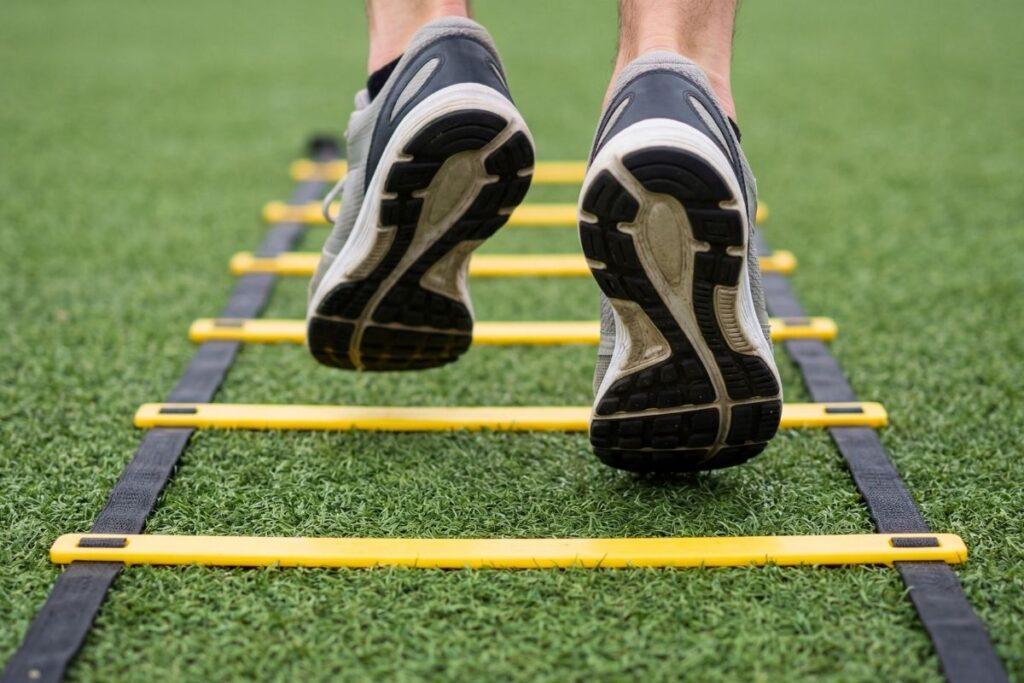
The top exercises for agility are targeted multi-directional training drills designed to rapidly improve foot speed, directional changes, deceleration, and reaction time. The most effective options include the 5-10-5 Pro Agility Shuttle, 3-Cone L-Drill, Agility Ladder Icky Shuffle, Lateral Bounds, Box Shuttles, and Reactive Mirror Drills.
Building true athletic speed requires solid body control and rapid neural firing across every direction. While cone shuttles, plyometric bounds, and quick footwork sharpen acceleration, mastering deceleration control and spatial awareness are equally critical for preventing injury and maintaining upright stability.
Let’s be real here. Raw straight-line speed is useless if you tumble. Stopping fast keeps you upright. Oddly enough, most people ignore deceleration drills. They just focus on sprinting. That is a huge mistake.
- Multidirectional Focus: True agility needs lateral and rotational control. Linear sprint speed is not enough.
- Deceleration Control: Stopping fast reduces joint stress. It allows quick shifts in direction.
- Neuromuscular Adaptation: Drills sharpen brain connections. They cut choice reaction time by 6.9%.
- Injury Prevention: Regular agility work cuts leg injury risks. Studies show a 30% to 50% drop.
- Progressive Overload: Learn fixed footwork patterns first. Add random visual cues later on.
The Science Of Rapid Movement
Agility is not just running straight. You must shift direction fast. Balance and posture stay active throughout. So does spatial awareness. Exercise scientists split agility into two types. These are Change of Direction Speed and Reactive Agility.
The first type involves planned movements. Think of weaving through fixed cones. You know where to go beforehand. Reactive agility adds random decision elements. You react to a defender’s quick move. Or you react to an unexpected pass.
Research shows SAQ drills sharpen neural drive. They boost motor unit recruitment. Clinical tests show 5% to 7% acceleration gains. That happens in short-distance sprints. Reaction times drop by up to 6.9%. That speed difference matters on the field.
Neuromuscular drills protect your joints too. Non-contact knee injuries drop by 30% to 50%. Ankle sprains happen far less often. Ligament strains decrease as well. Building joint resilience takes time. It pays off in the long run.
Let’s look at key performance numbers. Data highlights how agility impacts athletes.
| Performance Metric | Average Improvement | Primary Physiological Mechanism |
|---|---|---|
| Short Sprint Acceleration | 5% to 7% increase | Enhanced motor unit recruitment |
| Choice Reaction Time | Up to 6.9% decrease | Faster central nervous system processing |
| Non-Contact Injury Risk | 30% to 50% reduction | Improved joint stability and tendon stiffness |
| Ground Contact Duration | 10% to 15% reduction | Increased elasticity in lower-leg tendons |
Table Source: Institute of Human Anatomy & MDPI Applied Sciences Data.
The 6 Most Effective Exercises For Agility
1. The Agility Ladder Icky Shuffle
The agility ladder is a classic tool. It refines foot speed and cadence. It improves overall movement rhythm. The Icky Shuffle challenges your nerve pathways. Your brain coordinates side and forward steps.
- Execution: Stand at one ladder end. Step sideways into the first rung. Use your right foot first. Follow with your left foot. Step your right foot outside. Next, step your left foot inside. Follow with the right foot. Step the left foot outside. Repeat down the entire ladder.
- Benefit: It cuts ground contact time. It builds crisp foot-eye coordination.
2. The 5-10-5 Pro Agility Shuttle
People call this the short shuttle. It tests lateral acceleration and braking. Body orientation shifts in seconds. You must stay low to control momentum.
- Execution: Place three cones in a line. Space them 5 yards apart. Start at the middle cone. Assume a low athletic stance. Sprint 5 yards to your right. Touch the ground line. Pivot 180 degrees fast. Sprint 10 yards to the far left. Touch that line. Pivot and sprint 5 yards back. Finish at the middle cone.
- Benefit: It teaches low body positioning. You brake hard before exploding back.
3. The 3-Cone L-Drill
The L-Drill tests tight cornering. It demands clean velocity shifts. You make 90-degree cuts under full control. Oddly enough, people rush the turn. That causes slipping.
- Execution: Set three cones in an L shape. Space them 5 yards apart. Sprint 5 yards from Cone 1 to 2. Touch the line. Sprint back to Cone 1. Turn around immediately. Sprint past Cone 2. Weave around Cone 3. Cut tight around Cone 2. Sprint past Cone 1 to finish.
- Benefit: It builds hip mobility. Ankle stiffness improves on hard cuts.
4. Lateral Plyometric Bounds (Skater Jumps)
Real agility needs lateral force. Skater jumps build single-leg power. They create dynamic knee stability. You work in the frontal plane.
- Execution: Stand on your right leg. Bend your knee slightly. Push off hard to the left. Land softly on your left leg. Absorb force through your hip. Sweep your right leg behind. Pause for a brief second. Leap back to the right.
- Benefit: It strengthens hip abductors. Joints handle heavy stopping forces better.
5. The 4-Corner Box Shuttle
This drill blends multiple movement types. You combine sprinting, shuffling, and backpedalling. It creates one fluid workout loop. It keeps your lungs working hard.
- Execution: Set four cones in a square. Make each side 5 metres long. Sprint forward from Cone A to B. Side-shuffle sideways to Cone C. Backpedal cleanly to Cone D. Finish with a shuffle to Cone A.
- Benefit: It smooths movement changes. You switch locomotion styles without slowing down.
6. Reactive Mirror Drills
Fixed drills lack surprise elements. Mirror drills add random visual cues. Your cognitive processing speed jumps. You cannot guess moves in advance.
- Execution: Face a training partner. Stand 3 metres apart. Partner A moves in any direction. They go left, right, forward, or back. Partner B mirrors every single move. React instantly without delay.
- Benefit: It links physical speed with mental processing. Your reaction time improves fast.
ALSO READ: Judo Athletes: Masters of Balance and Strength
Drill Comparison & Biomechanical Benefits
Here is a breakdown of key drills. Compare their main focus and physiological gains.
| Exercise Drill | Primary Focus Area | Key Biomechanical Benefit | Difficulty Level |
|---|---|---|---|
| Icky Shuffle (Ladder) | Foot speed & cadence | Reduces ground contact time | Beginner |
| 5-10-5 Pro Shuttle | Lateral acceleration & braking | Teaches low centre of mass control | Intermediate |
| 3-Cone L-Drill | Tight cornering & cutting | Enhances hip rotation & ankle stiffness | Intermediate |
| Lateral Bounds | Single-leg explosive power | Boosts frontal-plane force production | Intermediate |
| 4-Corner Box Shuttle | Multi-directional locomotion | Smooths locomotion transitions | Advanced |
| Reactive Mirror Drill | Perceptual choice reaction | Accelerates brain-to-muscle response | Advanced |
Table Source: Adapted from Sports Science & Neuromuscular Training Guidelines (Institute of Human Anatomy & ACE Research).
How To Structure Your Agility Workout
Agility drills drain your nervous system. Do these sessions early in workouts. Your muscles and nerves must stay fresh. Do not do them after heavy strength work. That causes sloppy footwork and fatigue. Quality always beats quantity here.
- Frequency: Train 2 to 3 times weekly. Rest 48 hours between sessions.
- Volume: Keep drill sets short. Aim for 5 to 10 seconds per run.
- Work-to-Rest Ratio: Use a 1:3 or 1:4 rest ratio. Take 24 seconds rest after 6 seconds work. This allows nerve recovery.
- Progression: Learn basic foot patterns first. Add random visual cues later.
ALSO READ: Mistakes Climbers Make When Training Grip Strength
FAQs
Q1. How Often Should I Do Agility Drills Each Week?
Two or three weekly sessions work best. Agility demands high nervous system focus. Rest days allow muscle recovery and performance gains. Do not overdo it.
Q2. What Is The Main Difference Between Speed And Agility?
Speed is straight-line velocity. Agility is changing direction with control. It involves braking, turning, and acceleration. It also includes reacting to visual cues.
Q3. Can Agility Exercises Help With Fat Loss?
Yes, agility drills burn plenty of calories. They function like interval training. Large muscle groups work hard. Post-workout calorie burn stays elevated for hours.
Q4. Do I Need Special Equipment To Train For Agility?
No special gear is required. You can draw chalk lines on pavement. Water bottles work as substitute cones. Focus on movement quality instead.
Q5. Are Agility Drills Safe For Beginners?
Yes, if you scale the speed. Beginners should master movement mechanics first. Increase pace slowly as confidence grows. Avoid full-speed cuts early on.
Sources & References
- Institute of Human Anatomy. (2026). Effects of Agility Training on Athletic Performance & Neuromuscular Coordination.
- American Council on Exercise (ACE Fitness). (n.d.). Benefits of Speed, Agility, and Quickness (SAQ) Training for Non-Athletes.
- MDPI Applied Sciences. (2022). Effects of Agility Training on Skill-Related Physical Capabilities and Directional Changes.
- Latitude Performance. (n.d.). Speed and Agility Training: Key Performance Benefits.
Disclaimer: This article is provided for educational and informational purposes only and is not intended for promotional purposes or product endorsement. It does not constitute professional medical or health advice. Readers should independently verify all facts and seek professional advice from a qualified medical or fitness expert before undertaking any physical conditioning or agility training program.