
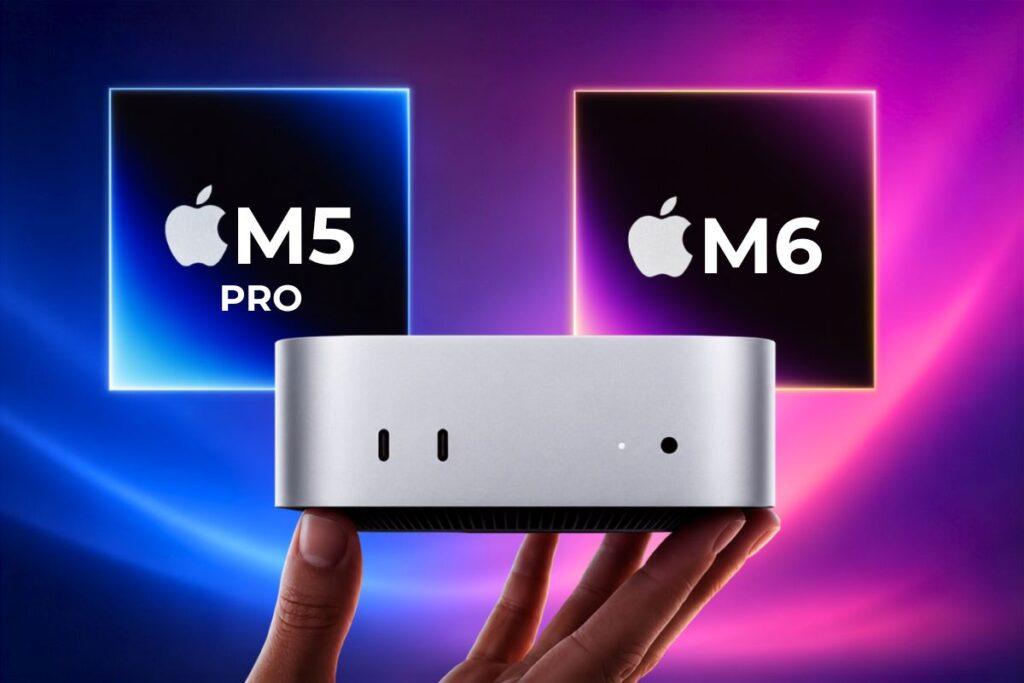
The Apple Mac Mini is a compact desktop computer that enters a new era featuring all-new, powerful 2nm M6 and M5 Pro chips. Engineered for daily productivity and demanding creative workflows, it brings massive performance upgrades to Apple’s ultra-compact desktop lineup.
It delivers up to four times faster AI processing and twice the graphics performance of previous generations. Designed specifically for local agentic AI operations, the updated system maintains its signature zero-footprint aluminium chassis while expanding connectivity options without compromising thermal management.
Let’s be real, tiny desktops usually compromise somewhere. Yet this compact box keeps expanding its connections. Apple claims substantial improvements across daily tasks. The physical size stays almost identical.
- Next-Gen 2nm Architecture: The base model debuts Apple’s 2-nanometer M6 processor.
- Extreme Pro Muscle: M5 Pro packs an 18-core CPU and 20-core GPU. Memory bandwidth reaches 307 GB/s on top setups.
- Dedicated AI Cores: Dedicated Neural Accelerators sit inside every GPU core. Local AI runs up to 4x faster overall.
- Next-Gen Connectivity: Features Wi-Fi 7, Bluetooth 6, and 2.5Gb Ethernet. Pro models add Thunderbolt 5 port connectivity.
- Release & Pricing: Pre-orders opened on 25 August 2026. Global store availability begins 22 September 2026.
The 2nm Revolution: Inside Apple’s M6 Chip
Small computers often struggle with heat management. The Mac Mini used to face that issue. Now, it houses Apple’s first 2-nanometer chip. They call this new silicon chip the M6. Engineers packed billions of extra transistors inside. The chip features a new 12-core CPU design.
Apple skipped traditional core layouts here. Instead, they built a hybrid core structure. It uses two high-performance super cores. Four standard performance cores handle main tasks. Six efficiency cores manage background processes quietly. Super cores tackle heavy single-threaded jobs quickly. Efficiency cores save power and reduce heat build-up. You know, thermal management matters in small cases.
Graphics capabilities expanded quite a bit too. The M6 contains a 12-core GPU block. That is two extra cores over older versions. Video editors get double the graphical performance. Interface designers also notice smoother UI animations. Unified memory bandwidth expanded to 170 GB/s. App switching feels instant during heavy multitasking.
Apple’s M5 Pro Chips: Bringing Heavyweight Power To A Compact Footprint
The standard M6 handles everyday office tasks easily. It works fine for light media editing projects. However, heavy workflows demand far more horsepower. That is where the M5 Pro configuration comes in. It targets software developers and 3D artists. Video colourists and data researchers benefit most. This tiny desktop pushes performance boundaries further.
The top M5 Pro offers an 18-core CPU. That includes ten performance cores and five super cores. It also carries a 20-core GPU block. Unified memory scales up to 64GB total. Bandwidth peaks at a fast 307 GB/s. It handles massive 8K video timelines smoothly. Complex 3D rendering in Blender runs without hiccups. Multi-track audio projects load rapidly.
Thunderbolt 5 support sets the Pro model apart. It delivers 120 Gbps of bi-directional bandwidth. Creators can daisy-chain external RAID storage units. Connecting three high-resolution monitors takes minimal effort. Oddly enough, developers can cluster multiple units together. They link M5 Pro boxes via Thunderbolt 5. That setup runs large AI models locally on-device.
ALSO READ: What Can You Learn About Protecting Your Digital Footprint and Online Identity?
On-Device AI: The Rise Of Agentic Computing
Local processing marks a major shift this year. Apple focused heavily on agentic computing to enhance on-device intelligence. Remote cloud servers have latency and privacy issues. This machine runs language models right on your desk. Automated agentic software executes tasks locally.
Engineers added Neural Accelerators into every GPU core. This applies to both Apple Mac Mini M6 and M5 Pro chips. A dual 16-core Neural Engine supports the system. AI prompts execute up to 13.5 times faster. That statistic compares performance against older M1 chips. It also runs 4.8 times faster than M4 systems.
What does this mean for everyday operations? Automatic video upscaling happens in real time. Background object removal completes in seconds. Live language translation works instantly without delays. Code generation runs locally on your drive. Your private files never leave your local desk. Data security stays fully under your control.
Performance Comparison: Apple’s M6 Vs M5 Pro Chips
| Feature / Specification | Apple Mac mini (M6 Chip) | Apple Mac mini (M5 Pro Chip) |
|---|---|---|
| Process Node | 2-nanometer (2nm) | Advanced 3-nanometer class |
| CPU Configuration | 12 Cores (2 Super, 4 Performance, 6 Efficiency) | Up to 18 Cores (5 Super, 10 Performance / 3 Efficiency) |
| GPU Cores | 12 Cores with Neural Accelerators | Up to 20 Cores with Neural Accelerators |
| Unified Memory | 16GB, 24GB, or 32GB | 48GB or 64GB |
| Memory Bandwidth | Up to 170 GB/s | Up to 307 GB/s |
| Thunderbolt Ports | 3x Thunderbolt 4 | 3x Thunderbolt 5 |
| AI Acceleration | Dual 16-core Neural Engine | Enhanced 16-core Neural Engine |
Table Source: Official specifications compiled from Apple Newsroom technical releases (August 2026).
Apple’s Mac Mini chips comparison table highlights key silicon differences clearly. Process node scaling drops down to 2-nanometer tech. Memory bandwidth jumps by nearly 80% on Pro models. Thunderbolt 5 offers double the throughput of Thunderbolt 4.
Design, Port Selection, And Display Support
The physical enclosure retains its familiar compact shape. Apple kept the zero-footprint aluminium chassis intact. The box sits neatly under most desktop monitors. An updated thermal cooling system keeps things quiet. Fans rarely spin up during routine tasks.
Front ports offer quick daily access. You get two standard USB-C ports up front. A 3.5mm headphone jack sits right beside them. It includes high-impedance support for studio headphones. The rear panel houses an HDMI port. Ethernet comes standard at 2.5Gb speed. Ten-gigabit options remain available for purchase. Three Thunderbolt ports line the back row. Notably absent is any built-in card slot, so anyone comparing Mini SD vs Micro SD card options for external storage will still need a separate reader or dock.
Display output flexibility remains strong here. The M6 runs two 6K displays at 60Hz. Alternatively, it drives one 8K display easily. Pro users can attach three displays total. That setup supports dual 6K plus one 5K screen. USB-C genlock support syncs video feeds precisely. Camera teams get microsecond timing accuracy for live broadcasts.
Pricing, Pre-Orders, And Final Verdict
Pre-orders opened on Tuesday, 25 August 2026. The initial launch covers 30 global regions. In-store sales begin officially on 22 September 2026. Deliveries start arriving on that same date. Verified students receive standard educational discount pricing.
Upgrading from Intel Mac desktops makes total sense now. Early M1 and M2 owners will notice speed gains. The 2nm process brings clear energy efficiency improvements. Dedicated AI hardware handles modern software demands. Quiet operation makes it a practical desktop choice.
ALSO READ: What Is Deep Learning Super Sampling (DLSS) and Why It Matters for Gaming
FAQs
Q1. What Is The Primary Difference Between The Apple M6 And M5 Pro Mac Mini?
The M6 model targets daily productivity and multitasking. It features 16GB to 32GB of memory. The M5 Pro handles heavy creative tasks like 3D animation. It offers 18 CPU cores and up to 64GB of memory.
Q2. When Will The New Apple Mac Mini Arrive In Retail Stores?
Pre-orders began on 25 August 2026. Retail store availability starts on 22 September 2026. Shipments to customers begin on that same day.
Q3. Does The New Apple Mac Mini Support External Multi-Monitor Setups?
Yes, it supports multiple external screens simultaneously. You can connect up to three monitors total. Resolutions reach up to 8K at 60Hz rates. High refresh rates like 4K at 240Hz work too.
Q4. Can I Upgrade The Unified Memory Or SSD Storage After Buying?
No, post-purchase internal upgrades are not possible. Memory and storage are soldered to the board. You must pick your preferred configuration when ordering.
Q5. Why Did Apple Add Neural Accelerators To Each GPU Core?
Adding accelerators to GPU cores enables parallel processing. Graphics and AI tasks run together efficiently. Local AI tasks execute four times faster than before.
Sources & References
- Apple. (2026, August 25). Apple unveils a more powerful Mac mini featuring the all‑new M6 and M5 Pro. Apple Newsroom.
- Apple. (2026, August 25). Apple introduces M6 and M5 Ultra for a big leap in performance and AI compute. Apple Newsroom.
- Wikipedia. (2026). Mac Mini.
- TechCrunch. (2026, August 25). Apple’s latest Mac Mini runs on a new M6 chip, and starts at $899.
- International Business Times UK. (2026, August 26). Mac Mini M6 release date, price and specs: Why M5 owners may face a difficult upgrade decision.
- MacRumors. (2026, August 25). Apple announces new Mac Mini with M6 and M5 Pro chips and more.
Disclaimer: The content provided in this article is for general informational and educational purposes only and does not constitute an endorsement, official recommendation, or promotional advertisement for any hardware or tech brand. While every effort has been made to present accurate technical details, hardware specifications and product release timelines may vary. Readers should independently verify all facts directly through official manufacturer channels and seek qualified technical advice before making purchasing decisions.





Great article, thanks for sharing!