
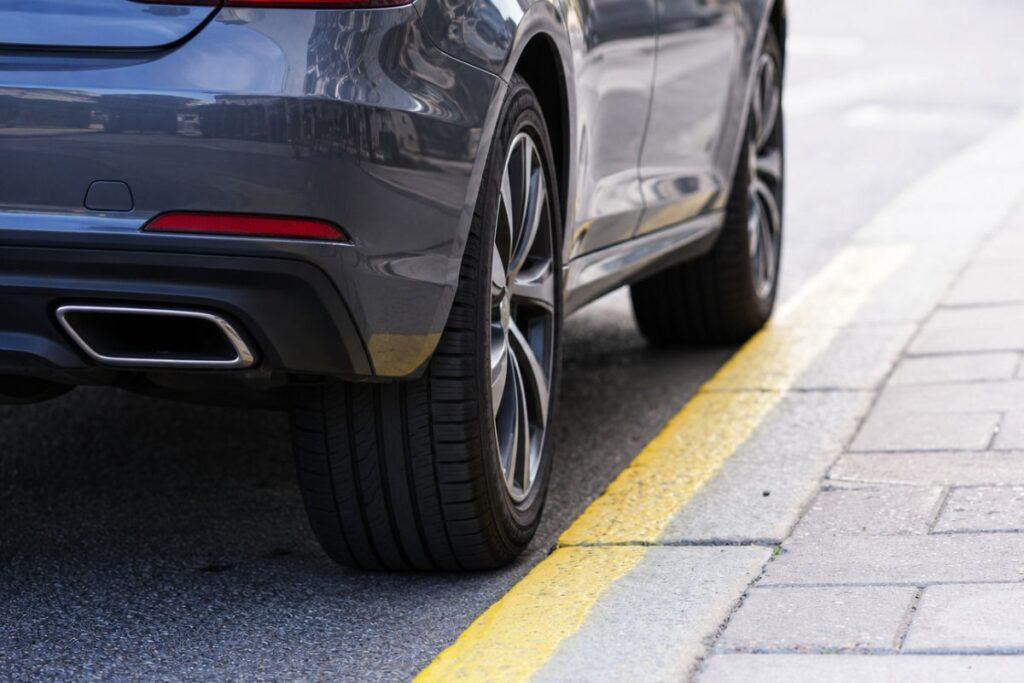
If you are wondering, “Can you park on a single yellow line without any penalty?” Then it’s wrong; park during those restricted hours, and a Penalty Charge Notice (PCN) is pretty much guaranteed. Outside the restricted hours shown on the nearby sign, that parking space is yours, and it’s free.
One yellow line isn’t a ban; it’s a clock. The paint says there’s a rule. The plate on the lamp post says when it’s switched on.
- A single yellow line bans parking and waiting only during the hours on nearby signs.
- The line gives no times. The time plate, or a Controlled Parking Zone (CPZ) sign, provides the times.
- Double yellows mean no waiting, ever, sign or no sign.
- Blue Badge holders usually get three hours, with the badge and clock on show.
- Loading and quick drop-offs are often fine, unless the kerb says no.
- Tickets run from £50 to £130, halved if you pay within 14 days.
What A Single Yellow Line Means
Your council painted it because parked cars cause bother there at certain times. Narrow roads jam up. Cars near junctions and crossings block the view. So parking goes off for part of the day and back on for the rest.
The RAC makes a useful point: some restrictions exist to keep traffic out of an area, not just moving. That’s common in bigger cities. You’ll spot them on high streets, in town centres and near stations and schools. The catch? Hours differ from one village, town or city to the next.
Sign Does All The Talking
Find the time plate before you lock the car. It’s small, yellow and black, usually on a lamp post, pole or wall, and it gives you the days it applies (say Monday to Saturday), the banned hours (say 8am to 6:30pm), and anything local like a one-hour maximum stay.
The Highway Code doesn’t matter. Rule 238 says: “You MUST NOT wait or park on yellow lines during the times of operation shown on nearby time plates (or zone entry signs if in a Controlled Parking Zone).” So “8am-6pm Mon-Sat” means you can park from 6:01pm to 7:59am, and all day on Sunday. The same attention to detail applies to other road rules, including the traffic lamp rules every UK driver should know.
What If There Is No Sign?
Don’t take silence as a yes. Nine times out of ten, you’re in a controlled parking zone, where the hours are on big signs at the edges of the zone, not on every street. Wander back to the junction and look. Still nothing? The council website will have it. As Regit puts it, a two-minute check can save you a £70 fine.
Glance at the other markings too. Zig-zags outside schools and crossings, red routes and bus or cycle lanes are a no at any hour. Parking isn’t the only rule drivers trip over, so it’s also worth knowing which car modifications are illegal in the UK.
Parking, Waiting, And Stopping Are Not The Same
Three words, three meanings, and wardens know the difference even if drivers don’t. Age UK spells it out: parking is leaving the car, waiting is sitting in it without getting out, and stopping is simply coming to a standstill.
In restricted hours you can’t park and you can’t wait. You can pull in briefly to let someone hop in or out, but you can’t idle there while they finish shopping. Where a sign says “no stopping”, even that drop-off is out.
How Long Can You Park On A Single Yellow Line?
There’s no national time limit. It depends on when the restriction starts again. Say the plate reads 8am to 8pm, Monday to Saturday. Turn up at 7am Monday and you’ve got an hour. Turn up at 8pm Saturday and you’ve got 36 hours. A plate saying “8am-6pm Mon-Fri” leaves you free from 6pm Friday until Monday. Some limit your stay to an hour or three, so check the details.
Parkers flags how much this swings between councils. Parts of Manchester city centre run from 8am to 8pm every day, while Westminster usually runs from around 8:30am to 6:30pm, with its weekend arrangements. If you’re driving into the capital, these tips for driving confidently in London are worth a look before you park up.
Single Vs Double Yellow Lines
| Condition | Single yellow line | Double yellow lines |
|---|---|---|
When it bites | Only during signed hours | All day, every day |
Needs a sign? | Yes, a plate or CPZ sign | No |
Can you park? | Yes, outside those hours | No |
Blue Badge | Up to three hours | Up to three hours |
Loading | Usually allowed | Unless the kerb says no |
The same rule is clear on doubles: “Double yellow lines indicate a prohibition of waiting at any time even if there are no upright signs.” This applies on Sundays and bank holidays too, whatever your mate thinks.
Check The Kerb, Not Just The Road
Those short yellow dashes across the kerb are loading restrictions. Drivers call them blips. One dash means no loading during the hours on the little black and white sign. Two dashes mean no loading or unloading at any time, and a blue badge won’t help you there.
Away from blips, loading on a single yellow is usually fine even in restricted hours, so long as it’s genuine, continuous and blocking nobody. Nip into the shop for twenty minutes and it stops being loading. Commercial drivers get the same leeway on doubles.
Blue Badge Holders
In England and Wales, a Blue Badge buys you three hours on single and double yellows, provided there’s no loading ban. The badge is in the window, and the clock is set to your arrival time, both clearly visible. Scotland drops the three-hour cap, but you still mustn’t block the road or pavement. Keep off paired blips, junctions and school zig-zags.
Saturdays, Sundays And Bank Holidays
Loads of plates stop at Saturday, leaving Sunday wide open, though plenty of busy streets run all seven days. Bank holidays are a coin toss: some councils lift restrictions, others don’t. No national rule covers it, so trust the plate. That matters most on weekend getaways, so check the plates in each town if you’re doing one of the top London countryside road trips.
Fines, Enforcement And Appeals
Civil enforcement officers, hired by councils or firms working for them, walk these streets daily, and cameras cover some spots. Those aren’t the only cameras to watch for, and it helps to know the different types of speeding cameras on UK roads. Near central London, clamping and towing are possible too.
Outside London, the higher-rate charge is £70, halved to £35 within 14 days, and lower-rate ones are £50. Jackwin Safety notes London tickets land between £80 and £130, with the same 50% discount.
Don’t shove a PCN in the glovebox. The charge climbs, and a council can get a Warrant of Execution and send bailiffs round, a power private parking firms don’t have.
Think it’s wrong? Challenge it. Faded paint, missing or confusing signs, or a badge clearly on display are fair grounds, and the instructions are on the ticket. Appeal within 14 days and you normally keep the discount if it fails.
ALSO READ: What Are Ghost Registration Plates? Here’s Why Dodging Cameras With Them Is Not Worth It
FAQs
Q1: Can You Park On A Single Yellow Line After 6pm?
Usually yes, as most restrictions end between 6pm and 8pm. Some run later or all day, so read the sign first.
Q2: Can You Park On A Single Yellow Line On A Sunday?
Often yes, as many plates say Monday to Saturday. Busy streets sometimes run all week, so check rather than assume.
Q3: Can You Stop On A Single Yellow Line To Drop Someone Off?
Yes, a quick drop-off or pick-up is fine even in restricted hours. You can’t sit and wait, and “no stopping” signs rule it out.
Q4: How Much Is The Fine For Parking On A Single Yellow Line?
Around £70 outside London and £80 to £130 in London. Pay within 14 days and it’s halved, so £70 becomes £35.
Q5: Can Blue Badge Holders Park On A Single Yellow Line?
Yes, up to three hours in England and Wales, with the badge and clock displayed. Paired yellow blips on the kerb cancel that.
Q6: What If A Single Yellow Line Has No Sign At All?
You’re probably in a controlled parking zone, with the hours posted at the zone entrance. Check there, or the council website, first.
Disclaimer: This article is published solely for general informational purposes and is not intended as a promotion or formal legal advice regarding UK parking laws and regulations. Readers should independently verify all facts, restrictions, and local signage, and seek professional advice before making any decisions related to motoring penalties.