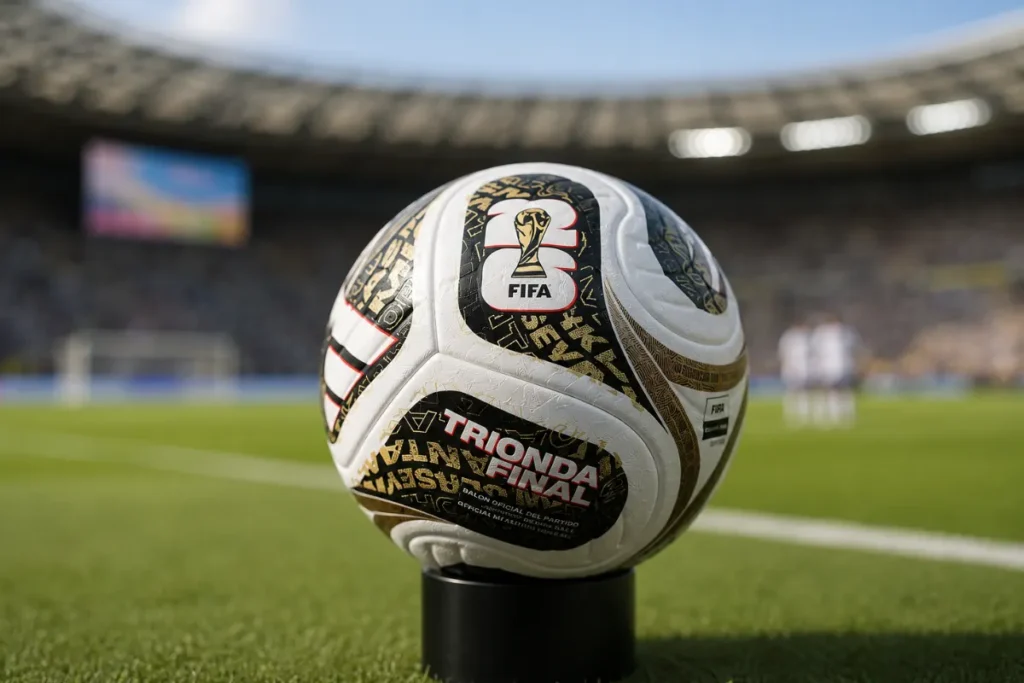
FIFA swapped in a new ball for the semi-finals, and honestly the reason’s pretty simple: Adidas made one just for this stretch of the tournament. Nobody’s done that before at a World Cup, a ball built purely for the semis, the third-place game and the final. Don’t expect it to play any different though. It’s the same ball underneath, just dressed up differently.
- The Trionda Final took over from the standard Trionda once the semi-finals began.
- First outing was the France vs Spain semi-final on 14 July 2026.
- Colours switched from the original’s red, blue and green mix to gold, black and white.
- All 16 World Cup 2026 host cities get a mention on the design.
- Under the hood, it’s the same ball, same build, same Connected Ball Technology.
- FIFA has been upfront that this is a styling update, nothing more.
So What Actually Is The Trionda Final?
Put simply, it’s Adidas’s match ball for the last four games of the tournament: both semi-finals, third place, and the final. Adidas put it out on 6 July 2026, calling it an evolution of the Trionda that had been used since the group stage.
The original ball leaned on reds, blues and greens, a nod to hosts Canada, Mexico and the US. This one ditches all that for gold, black and white instead. Adidas says the gold is meant to echo the World Cup trophy, which, fair enough, gives the closing matches a bit of a different feel from everything that came before.
ALSO READ: How Romelu Lukaku Helped Keep Belgium’s World Cup Dream Alive
Why Bother Changing It At All?
Here’s the thing that makes this genuinely new: no World Cup has ever done this before. Tournaments in the past stuck with one ball, maybe with a special final edition thrown in, but never a proper separate ball starting from the semis onward.
There’s a tribute angle here too. Dallas, Atlanta, New Jersey, Miami and New York, the four cities hosting the closing games, get top billing on the design. The other twelve host cities, think Toronto, Vancouver, Mexico City, LA, are tucked into the triangular patterns around the ball. Even Gianni Infantino came out and backed the change publicly before the semis kicked off.
And to be clear, Adidas isn’t pretending this fixes anything. Same four panels, same thermal bonding, same surface texture, same Connected Ball Technology chip feeding data to VAR. Players and keepers aren’t adjusting to a new ball performance-wise. It just looks different in their hands.
ALSO READ: Inside Lionel Messi International Retirement From Football: The Final Whistle
Trionda Vs Trionda Final, Side By Side
| Feature | Trionda (Group Stage Onwards) | Trionda Final (Semis Onwards) |
|---|---|---|
| Colours | Red, blue, green, white | Gold, black, white |
| Used for | Group stage through quarter-finals | Semis, third-place play-off, final |
| City branding | General tournament look | All 16 host cities named |
| Build | Four-panel thermal bonded | Identical construction |
| Connected Ball Tech | Yes | Yes, no changes |
| Launched | 2 October 2025 | 6 July 2026 |
Table Source: Official FIFA and adidas press releases for the FIFA World Cup 2026™ official match balls.
Does This Fix The Goalkeeper Complaints?
Funny enough, a few goalkeepers had moaned earlier in the tournament about the original Trionda being hard to read, especially on long shots. But that’s not what this update was for. Adidas has said the internals are unchanged, so whatever keepers were struggling with before is probably still there. This was never billed as a fix.
When Did Fans First See It?
The Trionda Final made its debut in the France vs Spain semi-final on 14 July 2026, played at Dallas Stadium in Arlington, Texas (Spain won that one 2-0, for what it’s worth). It showed up again the next day for Argentina vs England. It’ll also be used in the third-place play-off and the final on 19 July 2026.
ALSO READ: Cristiano Ronaldo Selfish Play: Is It A Fair Point or Harsh Take By Football Legends?
FAQs
Q1. Is The Trionda Final A Totally Different Football?
Not really. Same materials, same construction, same tech inside. Only the colours and the city branding changed.
Q2. Why Put 16 City Names On A Ball Only Four Cities Are Hosting Games In?
It’s meant as a nod to every host city across Canada, Mexico and the US that staged matches during this expanded World Cup, not just the final four.
Q3. Has FIFA Ever Swapped Balls Mid-Tournament Like This Before?
No, this is a first. No previous World Cup has introduced a dedicated ball starting from the semi-finals.
Q4. Will The New Ball Play Any Differently?
FIFA and Adidas both say no. Weight, flight, performance, all identical to the standard Trionda.
Q5. When Could People Actually Buy One?
Adidas released it for purchase on 7 July 2026, the same week it debuted on the pitch.
Sources & References
- FIFA. (2026). Trionda Final official match ball for the final four matches. FIFA.com – World Cup 2026 Articles.
- Yahoo Sports. (2026). FIFA’s unusual World Cup ball change explained. Yahoo Sports Football Coverage.
- YEN.com.gh. (2026). World Cup 2026: Reason behind FIFA’s new ball for semi‑final and final stages. YEN.com.gh Sports.
- Tuko.co.ke. (2026). Why a new ball is used in the 2026 World Cup semi‑finals and final. Tuko.co.ke Football News.
- Khel Now. (2026). FIFA World Cup 2026: Why is there a new ball in the semis? Khel Now Football.
- Wikipedia. (2026). Adidas Trionda. In Wikipedia.
Disclaimer: This article is intended solely for informational and educational purposes. It is not intended to promote, endorse, or advertise FIFA, Adidas, or any other organization, product, or service mentioned herein. While reasonable efforts have been made to ensure accuracy, readers should refer to official sources for the latest and most authoritative information.