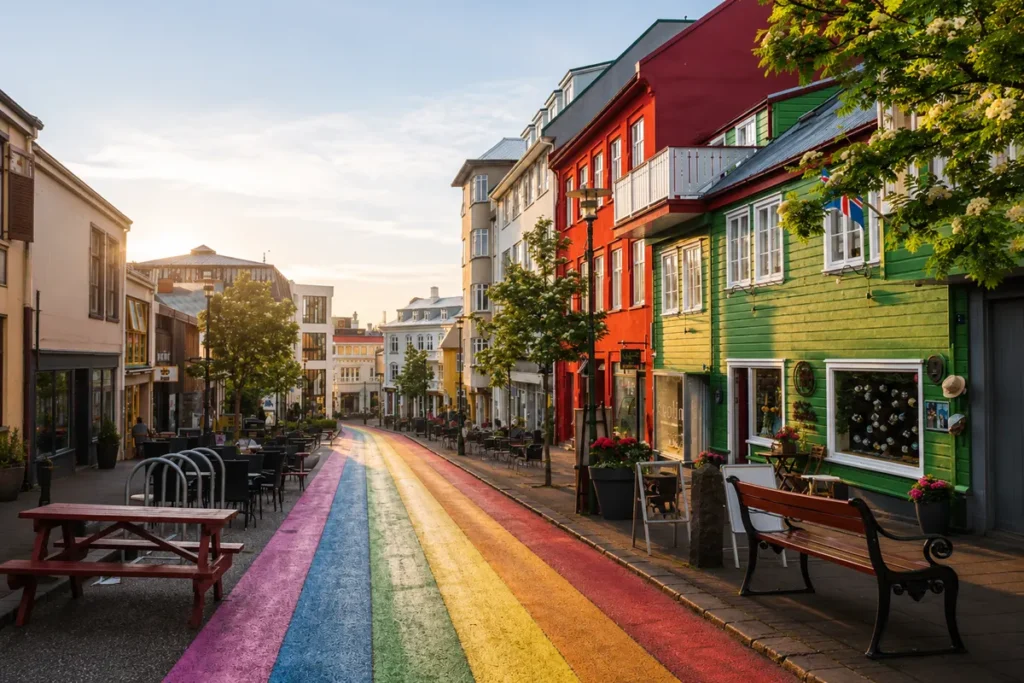
Reykjavík is the capital of Iceland and the world’s northernmost capital city of a sovereign state, situated right on the Faxaflói Bay at 64°08′ north.
Only about 139,000 people live here, but the wider capital region holds roughly 249,000 — nearly 64% of the whole country. Despite its small size, Reykjavík is often praised for its quality of life and strong sense of community. Here’s what’s worth knowing before you fly.
- It’s the world’s northernmost capital of a sovereign state.
- The name means “Bay of Smoke”, after steaming hot springs.
- Free volcanic heat warms basically every building in town.
- No McDonald’s, no Starbucks — but a puffin colony and a cat obsession.
- A perfect base for the Northern Lights, whales and the Golden Circle.
How It All Started
The story goes that a Norseman called Ingólfur Arnarson sailed over around 874. He threw his wooden seat pillars into the sea and vowed to settle wherever they washed up. His slaves then hunted the coast for three years before finding them in this bay.
Then not much happened for 900 years. The town was properly founded in 1786 as a trading post, built on wool, with sheriff Skúli Magnússon — the “Father of Reykjavík” — in charge.
Things sped up in the Second World War. Four British warships rolled in on 10 May 1940, a reminder of Britain‘s strategic role during the war.. Nobody fought back; locals even lent the troops their taxis and trucks. The Brits built the little city airport, the Americans built Keflavík 50km away (still the main one), and in 1944 Iceland became a full republic.
The city later pulled off two big moments too: the 1972 Fischer–Spassky chess match and the 1986 Reagan–Gorbachev summit at Höfði House.
ALSO READ: Harrogate – Safest City in the UK That Feels Like Home
A City Built On Stories
Reykjavík is a UNESCO City of Literature — the fifth in the world to get the title and the first that doesn’t speak English as a first language, back in 2011.
The old Icelandic sagas and the Poetic Edda were written here, and Halldór Laxness won the Nobel Prize for Literature in 1955. The Alþingi, set up in 930, is one of the oldest parliaments going. Its building downtown dates to 1881.
Don’t Fear The Cold
Wikipedia notes that winter rarely dips below -15°C, so it’s about as warm as New York, which sits 20 degrees further south. Thank the Gulf Stream. Summers stay cool, 10–15°C, but the light is mad.
From late May to late July it never really gets dark, while in December you get under five hours. It’s windy, cloudy, and rainy on roughly 147 days a year, so bring a good coat. The hottest day ever was 25.7°C in 2008; the coldest, −24.5°C, way back in 1918.
The Hot-Water Trick
Volcanic heat warms around 90% of every building in Iceland, and every single one in Reykjavík runs on geothermal heating. The same hot water fills the public pools and even melts snow off the pavements in winter.
The name fits a treat — it comes from old words for “smoke” and “bay”, after the steam from the springs. Getting around means driving, mind; Iceland’s car-mad and has no railways at all.
Activities You Can Do
There are heaps of things to do. The Times reckons it’s far more than a stopover, and they’re spot on. Climb the spire of Hallgrímskirkja — at 74.5 m, it’s the biggest church in Iceland — and lift yourself up for the view.
Snap the Sun Voyager, a Viking-style sculpture by Jón Gunnar Árnason from 1990. Gawp at Harpa, the glittering glass concert hall that opened in 2011, cost €164 million, and hosts the November Iceland Airwaves festival.
Pop into Perlan, a nature museum under a glass dome with a real indoor ice cave. Two Viking museums — the Settlement Exhibition and the Saga Museum — recreate the past. And yes, there’s the Icelandic Phallological Museum, with all 215 of its, er, exhibits.
Outside town, the city’s a springboard for some of the most dramatic natural landscapes. Hunt the Northern Lights from September to March – Grótta Lighthouse is a cracking spot. Go whale watching from the old harbour for minke, humpback, and even blue whales, as well as dolphins.
Soak in the Blue Lagoon, 20 minutes from the airport, or the clifftop Sky Lagoon. Then there’s the Golden Circle and Thingvellir, where you can swim right between two tectonic plates.
Food, Beer And A Famous Hot Dog
Hungry? Dill holds Iceland’s only Michelin star. The brave can try hákarl — fermented shark — at the Kolaportið flea market. But the real classic is Bæjarins Beztu Pylsur, a hot-dog stand open since 1937 that has served Bill Clinton and Metallica. Ask for “ein með öllu” (one with everything).
At night, Laugavegur is the place; bars sit a few steps apart and folk hop from one to the next. Odd one: beer was banned here until 1 March 1989, so a drink at home first is still the norm.
Quirky Facts You Should Know
A few crackers. Arctic Adventures points out that Reykjavik is the only capital in the world with its puffin colony, which nests nearby from May to August.
It’s also the only Western European capital with no McDonald’s. Dogs were banned from 1924 to 1984, so it became a cat city and stayed one. And Visit Reykjavik explains that Laugavegur, the main street, roughly means “hot spring road” — women once carried their washing there to clean it in the warm water.
ALSO READ: Longyearbyen, Norway – The World’s Northernmost City In The Arctic Region
When Should You Go?
Any time works. September to March is best for the aurora, summer for the midnight sun, and spring and autumn are good for saving a few quid.
It’s less than a two-hour flight from London, and around 2.3 million people visited in 2024 — so you won’t be alone. You’ll soon see why they keep coming back.
Sources & References
- The Times. (2026). Best things to do in Reykjavik.
- Arctic Adventures. (2026). Reykjavik: Iceland’s capital city and puffin colony.
- Visit Reykjavik. (2026). 11 little‑known facts about Reykjavik.
- Wikipedia. (n.d.). Reykjavik
Disclaimer: This article is provided solely for informational and educational purposes. The content is based on publicly available information and should not be considered professional travel, legal, financial, or other specialised advice. References to locations, attractions, products, or services do not constitute endorsement, recommendation, or promotion. Readers should independently verify any information before making travel or related decisions.