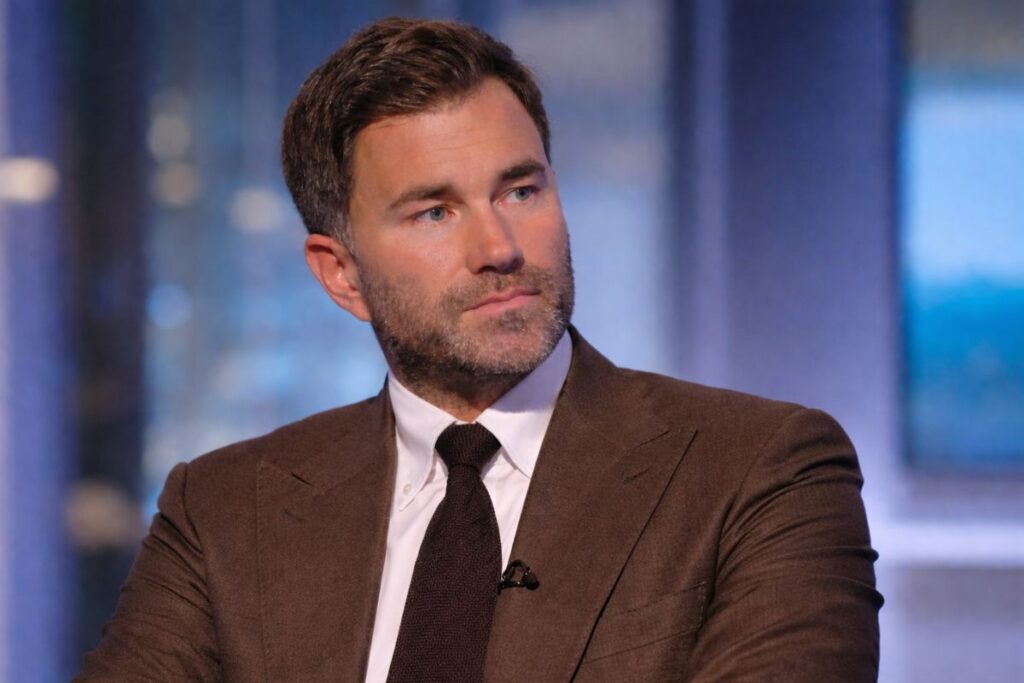
You don’t really “meet” Eddie Hearn the first time you see him. You get hit by him.
A clip pops up. He’s grinning. He’s talking fast. He’s half selling a fight, half teasing the other bloke who’s trying to sell the same fight. The tone is always the same. Confident. Slightly cheeky. Like he’s walking into the room already mid-argument.
And it’s easy to miss what’s going on underneath all that noise.
Because “Eddie Hearn, promoter” isn’t just a job title. It’s a whole way of running sport. He took a very British, very old-school industry and dragged it into the streaming age, with all the mess that comes with that. Some fans love him, while others can’t stand him. Either way, he’s become one of the most visible people in boxing, often more famous than the fighters on his posters.
If you’re wondering how he got there, it helps to remember boxing isn’t only about punches. It’s about contracts, dates, broadcasters, venues, sponsors, egos, and the small miracle of getting two teams to sign the same piece of paper.
Hearn’s been doing that part for years. Loudly, publicly, and sometimes it’s like a sport of its own.
Matchroom: The Family Business
Eddie Hearn didn’t build Matchroom from scratch. His dad, Barry Hearn, created the company and turned it into a serious sports promotion business long before Eddie became the face of it.
But the “nepo baby” label doesn’t explain much on its own. Plenty of people inherit good positions and still manage to mess it up.
Eddie came into Matchroom in 2000 and worked across parts of the business that had nothing to do with boxing glory. Golf management. Poker and gaming. Sponsorship and events. It’s not the romantic side of sport, but it teaches you something useful. How money moves. How brands think. How audiences behave when the product is boring.
Then boxing became his main stage.
Wembley Nights, And Why They Mattered
If you want the simple version of why Eddie Hearn became a household name in British boxing, it starts with stadium fights and the nerve to actually try them.
Anthony Joshua’s rise is the obvious example. Joshua vs Klitschko at Wembley in April 2017 is still the night people bring up first, partly because Matchroom said the crowd was about 90,000 and it genuinely felt like the country had decided boxing mattered again for one evening. It wasn’t just a fight. It was an event. The sort you plan your weekend around.
Then came the second proof that Matchroom could scale twice, not once. Carl Froch vs George Groves II at Wembley in 2014 pulled roughly 80,000, which told everyone a big British grudge match could fill a stadium too, not only a heavyweight title storyline. That night helped normalise the idea that outdoor mega shows weren’t a mad risk. They were a business model.
And here’s where people sometimes oversimplify Hearn’s run. It isn’t only “Joshua, Wembley, job done.” His era also sits alongside the modern Canelo machine.
Matchroom promoted Canelo Álvarez in the UK for the Billy Joe Saunders and Caleb Plant fights in 2021, both staged in the US, both huge nights, and both part of that wider period where boxing became more global and less tied to one country’s TV schedule.
Those fights matter because they show the pattern. Hearn sells scale, such as big venues, big narrative hooks, and big confidence.
Even when boxing gets messy and negotiations turn into a public soap opera, he still leans into the spectacle, because spectacle is what makes casual fans pay attention.
The Quiet Part Behind The Noise: Going International
Matchroom’s growth under Hearn didn’t stay in Britain. The company pushed harder into the US market in the late 2010s and later expanded Matchroom Boxing’s footprint across Europe and other regions through partnerships, local events, and fighter signings that weren’t only UK-focused.
You can see that shift in Matchroom’s own corporate profile and how often their fight calendar stopped looking “British first”.
And that international push is what made the DAZN move make sense later. If your audience is global, you want a platform that’s built to reach global subscribers. Wembley gave him the reputation. The overseas expansion gave him leverage.
That’s the real milestone chain, and it’s why the Eddie Hearn promoter story keeps showing up in any conversation about what boxing looks like now.
ALSO READ: Jimmy Tarbuck – Still Making Britain Laugh at 85 Years Age
Streaming Changed Everything
In June 2021, Matchroom signed a five-year global deal with DAZN, which was widely reported as a major move away from the long Sky Sports relationship.
Reuters covered the deal at the time, noting that Anthony Joshua’s fights were not included and would still be negotiated separately. The Guardian also reported the same point.
That detail matters, because it shows the reality of boxing. Even a powerful boxing promoter doesn’t control everything. Some stars operate almost like their own companies.
Still, the DAZN move signalled something clear. Hearn wanted boxing to live on streaming, with more regular shows, more content, and more global reach. It was a bet that fans would follow the sport across platforms, not just turn up for a few pay-per-view nights.
Did it fix boxing? No. Boxing doesn’t get “fixed”. But it shifted the centre of gravity.
ALSO READ: Russell Brand Net Worth: The Money Story Behind The Noise
Eddie Hearn’s Personality And Leadership Style
Eddie Hearn doesn’t act like a promoter who hides behind closed doors. He talks. A lot. He’ll do the interviews, take the awkward questions, and keep turning up even when the headlines are rough. That’s part confidence, part strategy.
With fighters, he often plays two roles at once. Hype man in public, problem solver in private. When fans get upset about a date, an opponent, or a price, he tends to step in front of it. Better they aim the frustration at him than at the boxer you’re trying to build.
And he knows the fan game. He speaks in clips, not essays. He understands that a quick line can carry further than a long explanation, especially online. Some people love that. Others find it maddening. Both reactions still keep the fight in the conversation.
Compared with someone like Bob Arum, who’s done decades of deal-making and can feel more old school, Hearn is more “always on”.
And compared with Frank Warren, whose style is famously combative in the British scene, Hearn leans more into charm and speed, even when he’s throwing verbal jabs. Different flavours. Same business.
Rivalries, Rows, And The Bits Fans Remember
Hearn’s rivalries with other promoters aren’t a side story; they’re part of the main plot. In Britain, the back and forth with Frank Warren has often turned into a public tug of war over dates, venues, broadcasters, and who gets top billing. Fans see it as ego. Promoters call it leverage. Either way, it’s one reason big fights can take forever to land.
Matchmaking is another flashpoint. Critics have accused him of keeping certain fighters “safe” for too long or building cards that look good on paper but feel one-sided on the night.
When a prospect gets fed softer opponents, people blame the promoter. When that same fighter loses the first real step up, people blame the promoter again. Boxing doesn’t do fair.
Then there’s money. Fighters and trainers talk, and fans read between the lines. Hearn’s defenders say he’s helped raise purses by bringing more TV and streaming money into the sport.
Detractors say the business still favours the house, and that some fighters get paid well while the undercard grafts for far less.
And because he’s always on camera, the feuds never stay private. He’ll trade lines with rival camps, he’ll push back on journalists, and he’ll argue his case in public instead of letting a press officer do it. That approach sells fights, but it also keeps the noise loud even when everyone should probably calm down.
Matchroom Isn’t Only Boxing
One reason Hearn stays powerful is that Matchroom isn’t just one sport. He’s chairman of Matchroom Sport and also the Professional Darts Corporation, which means his influence reaches far beyond the ring.
That broader base matters because it stabilises the business. Boxing can be feast or famine. Other sports provide steady events, steady audiences, and steady revenue. It also means he’s thinking like a sports executive, not only a boxing man.
And yes, he’s made blunt comments about other sports too. Sometimes it sounds like a hot take. Sometimes it’s a negotiation tactic in public.
With Hearn, it’s hard to separate those two.
Monaco, And What It Signals
By 2024 and 2025, the rumours of Hearn’s relocation were confirmed by official filings. As of April 2025, public record filings in the UK officially listed Eddie Hearn as a resident of Monaco.
While it’s easy to dismiss this as a simple tax play following UK residency rule changes, the move is actually a massive business signal.
In 2026, Hearn is no longer just a “British promoter” fighting for a slot on Sky Sports; he has become an international sports mogul. Monaco is not just a home; it is a hub that places him at the centre of the Mediterranean luxury and sporting circuit.
The Money Plan Behind The Noise
People treat Eddie Hearn like he’s just chat. The bigger story is the business underneath.
Broadcast rights sit at the centre. Matchroom’s 2021 deal with DAZN pushed more boxing towards subscriptions instead of relying only on big pay-per-view nights. Reuters also noted a key detail: Anthony Joshua fights weren’t part of that package and would be negotiated separately, which shows how the very top names can still sit outside any “exclusive” deal.
Then there’s sponsorship. Promoters sell attention as much as tickets, so brands, venue partners, and broadcasters all feed the same machine. Bigger nights bring bigger sponsors, which helps fund deeper cards.
The risky move is expansion. Running shows outside the UK costs more and carries more uncertainty, but if it works, you’re no longer boxed in by one market. And that shift has changed boxing’s money flow too: platforms want steady content, fighters chase guarantees, and the sport starts to feel like a weekly feed rather than a few massive nights a year.
What Comes Next When The Joshua Era Fades
Hearn’s future question is simple to ask and, in early 2026, increasingly hard to answer.
What happens when your biggest star, the man who practically built the modern Matchroom house, is forced to step away?
Anthony Joshua has been the sun that Matchroom’s boxing universe rotated around. But following the devastating car accident in Nigeria in late December 2025, that sun has temporarily gone dark.
In a rare moment of promotional restraint, Hearn has spent the start of 2026 telling the media that “boxing can wait”, prioritising AJ’s recovery over any fight contract. It’s a move that shows a different side of the promoter: a man who knows that even in a business built on theatre, some things are too real to hype.
The next era now depends on whether Matchroom can keep building stars from scratch rather than just staging events. With Dana White’s Zuffa Boxing launching a full-scale “war” on the traditional promotional model this year, Hearn is no longer just defending his dates; he’s defending his territory.
He’s already leaning into the crossover space and influencer-driven events; the kind of stuff traditionalists loathe. But in 2026, these events are not just sideshows; they are the engine room for younger audiences. Hearn knows that promoters do not follow tradition; they follow attention. That is, and always has been, the job.
Final Thoughts
So, is Eddie Hearn a genius or just another salesman, perhaps a bit of both?
Probably both. He sells fights for a living. That does not make him fake; it means he is a perfect fit for boxing, where truth and theatre have been sitting in the same chair since time immemorial.
If you wonder whether the “Eddie Hearn promoter” era will prove to be a temporary trend or an enduring force, consider simply how the world has evolved in his wake. The streaming shift, the move to Monaco, and the fact that promoters are now public icons rather than hidden deal-makers. Those changes do not roll back easily.
Anyway, next time you see his face in a clip, ask yourself one thing: are you watching a promoter talk, or are you watching the next big fight get built in real time?
Sources & References
- UK Companies House: Edward John Hearn – Personal Appointments. Official filings confirming residency change to Monaco (April 2025).
- Matchroom Sport: Official Board of Directors – Eddie Hearn Profile. Detailed history of his start in Golf Management (2000) and Poker (2005).
- Wembley Stadium: Event Archive: Joshua vs. Klitschko. Data on the record-breaking 90,000 attendance (April 2017).
- Reuters: Matchroom and DAZN strike five-year global broadcast deal (June 2021). Analysis of the shift from Sky Sports and the exclusion of Anthony Joshua’s rights.
- The Guardian: Eddie Hearn boasts $1bn transatlantic streaming deal. Context on the initial US expansion that funded the global pivot.
- Sports Illustrated: Eddie Hearn Makes Big Bet On Boxing In Monaco. Analysis of the promoter’s relocation and its impact on European boxing (April 2025).
- AFP / CBS News: Boxing star Anthony Joshua injured in fatal car crash in Nigeria. Detailed report on the December 29, 2025 accident and Hearn’s subsequent hiatus announcement.
- UFC / TKO Group: Paramount Announces Landmark Media Rights Deal With Zuffa Boxing. Details on Dana White’s 2026 entry into boxing and the Paramount+ partnership.
- WBC Boxing: Queensberry wins the 5 vs 5 Tournament. Results of the historic Matchroom vs. Queensberry rivalry event in Riyadh (June 2024).
Disclaimer: This article is provided for informational purposes only. While reasonable efforts have been made to ensure the accuracy and reliability of the information presented, no guarantee is made regarding its completeness, accuracy, or timeliness. The content does not constitute any specialised advice and should not be relied upon as such. Readers are encouraged to conduct their own research and consult qualified professionals before making any decisions based on the information contained in this article.