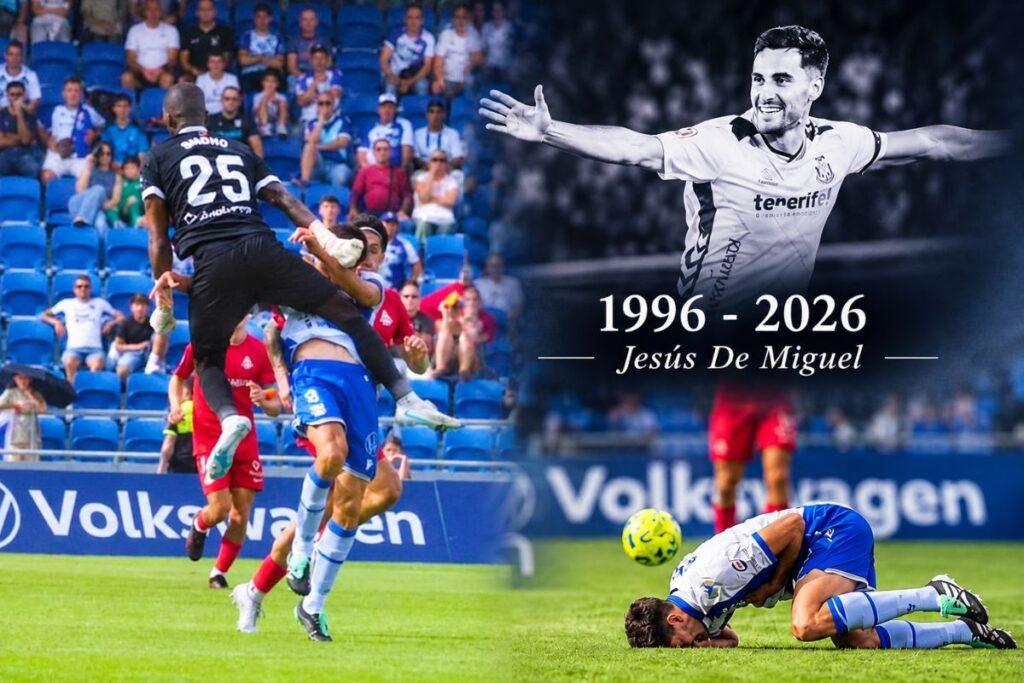
The 30-year-old Tenerife striker Jesús de Miguel died on 3 November 2026, a day after colliding with Andorra goalkeeper Jesús Owono in a second-division match. He suffered a cardiac arrest and was treated in intensive care. Police have opened a routine inquiry.
- De Miguel was 30 and played for CD Tenerife in Spain’s second tier.
- The collision happened on 2 November, seven minutes into added time.
- Andorra’s goalkeeper was sent off, and the match was abandoned.
- Spanish police opened an investigation, which authorities describe as standard.
- LaLiga and UEFA have paid tribute, and Tenerife’s next match may be postponed.
What Happened On The Pitch
Tenerife hosted Andorra on Monday, 2 November, at the Estadio Heliodoro Rodríguez López. Al Jazeera reports that De Miguel came on as a substitute in the 59th minute with Tenerife 2-0 up. The game finished 2-2 on the scoreboard, but it never really ended.
Deep in stoppage time, a cleared ball bounced towards midfield. Owono came out to meet it and clashed with De Miguel. His knee appeared to strike the striker’s chest. The referee showed Owono a red card straight away. Contact injuries are part of football, and fans are used to following player injury updates, but a collision with this outcome is extremely rare.
Medical staff ran on and worked on De Miguel for more than five minutes, according to Sky Sports. An ambulance then took him to hospital in Santa Cruz. The match was abandoned.
ALSO READ: Inside The Sports Career of John Stones: Modern Football Defender Masterclass
The Hours That Followed
De Miguel was admitted to intensive care. Spanish media, as cited by Al Jazeera, reported that he suffered a cardiac arrest in the ambulance.
On Monday night, he was described as “stable despite the severity of his condition”. By early Tuesday, doctors said his condition had worsened neurologically. He died later that day.
Tenerife announced his death on Tuesday morning. The club said it was racked with pain and asked for privacy for his family.
A Quick Timeline Of The Incident
| When | What Happened |
|---|---|
| Mon 2 Nov, 59th minute | De Miguel comes on as a substitute |
| Mon 2 Nov, 90+7 | Collision with Owono; goalkeeper sent off |
| Mon 2 Nov, night | Hospital says he is stable but seriously ill |
| Tue 3 Nov, early | Condition worsens neurologically |
| Tue 3 Nov | Death announced |
Table Source: Al Jazeera; Sky Sports.
Who Was Jesús De Miguel?
De Miguel was born in Madrid. According to Al Jazeera, he began at Leganés B in 2015 and went on to play for eight other Spanish clubs. He made his professional debut with Castellón in 2024. He finished as the club’s top scorer with 16 goals as they won promotion.
Tenerife signed him on a three-year deal in 2025. He was a late-blooming striker who had worked his way up the lower leagues. That path makes the loss feel even sharper for many supporters.
Is There An Investigation?
Yes, but the word “investigation” sounds more dramatic than it is here. Sky Sports reports that Spanish police opened an inquiry into possible involuntary manslaughter. Canary Islands judicial authorities said this is standard practice. Under Spanish law, any non-natural death triggers a judicial inquiry.
No official cause of death has been published in the sources reviewed. Cardiac arrest is what has been reported. Anything beyond that is speculation, and it is best left until officials say more.
How Football Has Responded
The reaction has been wide. Andorra, Barcelona, Real Madrid, LaLiga, UEFA and Arsenal all sent condolences, Sky Sports says. UEFA said matches this week will begin with a moment of silence. Arsenal held a minute’s silence at training.
LaLiga president Javier Tebas said he would talk to Tenerife about postponing their next game. He also floated a joint tribute across both professional divisions. Any pause would also give players and staff time to process what happened, and looking after mental health after a shock like this matters for everyone close to the club.
It is worth remembering that Owono’s challenge appears to have been an attempt to clear a loose ball. Nothing in the reporting so far says otherwise. The red card was an in-the-moment call, not a finding.
Why These Moments Feel So Shocking
Serious on-field collapses are rare, but they linger in the memory. Fans remember them because they happen in public, in a space that feels safe. Part of the shock comes from how closely elite players are monitored, from how professional athletes train to how they recover between matches. A routine challenge is not supposed to end like this.
That is why the details matter, and why the careful wording matters too. At this stage, what we know is limited. A collision happened, a cardiac arrest was reported, and a man died. The medical explanation will come from doctors, not from replays.
ALSO READ: Arsenal’s Young Gun Ethan Nwaneri Could Be Ready For A Leap
FAQs
Q1: When Did Jesús De Miguel Die?
He died on Tuesday, 3 November 2026, a day after the match on 2 November.
Q2: How Old Was He?
He was 30.
Q3: Who Did He Collide With?
Andorra goalkeeper Jesús Owono, who was sent off immediately.
Q4: Was The Match Finished?
No. It was abandoned seven minutes into stoppage time, with the score at 2-2.
Q5: What Was The Cause Of Death?
No official cause has been published. Spanish media reported a cardiac arrest after the collision.
Disclaimer: This article is published for informational purposes only and is not intended for promotion or commercial gain. Readers are strongly advised to independently verify facts, consult official sources, and seek professional advice regarding any legal, medical, or sports-related matters discussed herein.