
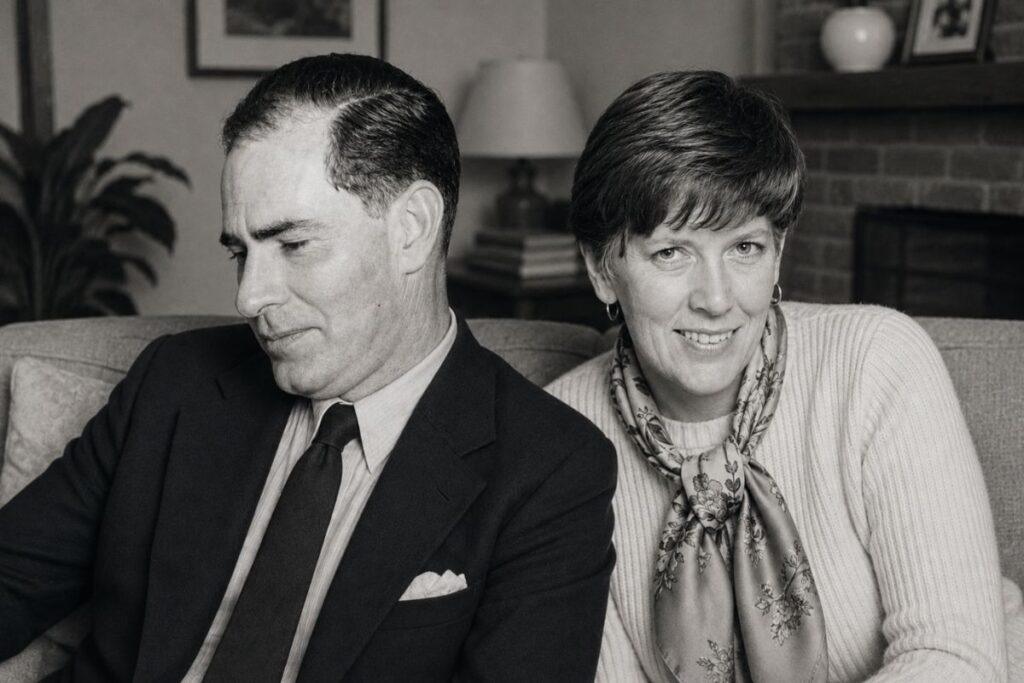
Rayne Kruger was a South African-born writer, historian and property developer. He wrote the best-selling Boer War history, Goodbye Dolly Gray, and later became the business brain behind his wife Prue Leith’s restaurant empire. He died in December 2002, aged 80.
- Born Charles Rayne Kruger on 29 January 1922 in Queenstown, Eastern Cape.
- Wrote six novels before turning to history.
- Goodbye Dolly Gray (1959) sold heavily and stayed in print.
- The Devil’s Discus (1964) was banned in Thailand.
- Married actress Nan Munro, then Prue Leith, in 1974.
- He is the father of Danny Kruger MP and filmmaker Li-Da Kruger.
A Rocky Start In The Eastern Cape
His mother, Patricia Kennedy, was 17 at his birth, the daughter of a British officer from the Boer War. His father walked out, so she married Victor Kruger, a Johannesburg estate agent. The boy took his stepfather’s name and attended Jeppe High School.
The Telegraph’s obituary recalled bailiffs seizing young Rayne’s set of Dickens. He stopped them by claiming the books were the tools of his trade.
He was sent down from the University of the Witwatersrand within a year, after donkeys he borrowed for a derby went missing. In 1942 he became an articled clerk at Bowen, Sessel and Goudvis.
War At Sea
Poor eyesight barred him from the armed forces, so he joined the British Merchant Navy as a steward, sailing from Durban on a tanker. He spent a year crossing the Middle East and the Far East.
Submarines threatened constantly, yet the ship survived. The voyage gave him his first novel, Tanker (1952). Back in Johannesburg in 1945, he qualified as a lawyer and topped the Transvaal exams.
ALSO READ: Which Degrees Have The Highest Salaries? The Top Earning Options
Pygmalion And A First Marriage
He joined the theatre company run by Nan Munro and Margaret Inglis. On tour with Pygmalion, the 24-year-old Kruger played Professor Higgins to the 40-year-old Munro’s Eliza Doolittle. She was a widow with three children, 16 years his senior. They fell in love, sailed for England and married in London the next year.
Munro returned to the West End while Kruger read the news for the BBC World Service. His play The Green Box ran briefly at the Chepstow Theatre, and he wrote on Albert Schweitzer’s Gabon mission for the Sunday Dispatch.
Who Is Rayne Kruger, The Author? His Books
Wikipedia lists nine titles, six of them fiction.
Publication Year | Name of Book |
1952 | Tanker |
1953 | The Spectacle |
1953 | Young Villain With Wings |
1954 | My Name is Celia |
1955 | An Even Keel |
1956 | Ferguson |
1959 | Goodbye Dolly Gray: The Story of the Boer War |
1964 | The Devil’s Discus |
2003 | All Under Heaven |
Table Source: Official Published Works of Author Rayne Kruger (1952–2003) as per Wikipedia.
The Book That Made His Name
For Goodbye Dolly Gray, he returned to Johannesburg to interview survivors and comb the records to document a conflict that involved over 448,000 British and Imperial troops and resulted in more than 22,000 military fatalities and 46,000 civilian deaths (National Army Museum). It was the first modern one-volume account, strong on the fighting but alert to the politics. AJP Taylor grumbled; readers did not. The Times Literary Supplement praised its calm handling of the campaigns.
A Banned Book And A Royal Mystery
The Devil’s Discus examined the death of Ananda, the 20-year-old King of Siam, who was found shot in his bedroom in 1946, with a Colt .45 beside him. Three servants were executed for it. Kruger’s research pointed to suicide after a forbidden romance with a Swiss girl. Thailand banned the book, a firm printing an illegal edition burnt down, and he was barred from returning.
ALSO READ: Esther Walker: Meet Lifestyle Journalist, Author And Podcast Host
The Businessman Behind The Books
Writing did not pay enough. With two South African friends, he set up Sohox, a property company that develops offices in Soho, flats by Regent’s Park, and land at Wimbledon. He also backed one of Britain’s first free newspapers, the Orpington News Shopper, with David English and Gerald McKnight, later selling it to Rupert Murdoch.
Rayne Kruger’s Wife: Prue Leith
Prue was the daughter of his old friend Sam Leith and the actress Margaret Inglis. She reached London in the early 1960s with £100 and a minivan. Kruger let her turn the ground floor of a Notting Hill house into a restaurant. Leith’s opened in 1969; the cookery school followed in 1975—pioneering an industry that, according to Dataintelo, grew into a $7.2 billion global chef training service market by 2025, with culinary arts accounting for 38.5% of total revenues.
They also had a secret. Speaking to The Sun, Prue said, “We did have 13 secret years, and nobody ever guessed because we were discreet.” She told Nan only when she wanted a baby. Kruger separated from Munro in 1973 and married Prue in October 1974. Their son Danny arrived three days later, and a one-year-old Cambodian orphan, Li-Da, was adopted the next year.
Accepting her 1990 Businesswoman of the Year award, Prue told The Times, “He was older and wiser and saved me from financial catastrophe several times.”
ALSO READ: Leading Ladies: Influential Women in British History
Final Years At Chastleton Glebe
They settled at Chastleton Glebe, an 18th-century house near Moreton-in-Marsh with a five-acre garden. Kruger spent 25 years on Chinese history and painted a garden pavilion in oriental red.
He finished All Under Heaven days before dying of emphysema on 21 December 2002. On Katherine Ryan’s What’s My Age Again podcast, Prue called him “a walking lesson on not smoking, because he smoked himself to death.”
Danny Kruger is now MP for East Wiltshire, having joined Reform UK in September 2025. On Davina McCall’s Begin Again, Prue said: “I absolutely adored him.”
FAQs
Q1. Who Is Rayne Kruger?
A South African-born author, historian and property developer. He wrote Goodbye Dolly Gray and helped build Prue Leith’s food business.
Q2. Who Was Rayne Kruger’s Wife?
He married twice: first the actress Nan Munro, then the restaurateur Prue Leith in October 1974.
Q3. How Did Rayne Kruger Die?
He died of emphysema on 21 December 2002, aged 80. He had been a heavy smoker for most of his life.
Q4. What Is His Most Famous Book?
Goodbye Dolly Gray (1959), his history of the Boer War. It sold strongly and has stayed in print.
Q5. Why Was The Devil’s Discus Banned?
It argued the young King of Siam died by suicide in 1946, not murder. Thailand banned it and barred Kruger from the country.
Q6. Who Are Rayne Kruger’s Children?
Two, with Prue Leith: Danny Kruger, MP for East Wiltshire, and Li-Da Kruger, a film-maker adopted from Cambodia.
Sources & References
- The Times. (2026). Rayne Kruger: Prue Leith recalls his wisdom and financial guidance.
- The Sun. (2026). Prue Leith reveals 13‑year secret affair with Rayne Kruger.
- Wikipedia. (2026). Rayne Kruger. In Wikipedia. Retrieved September 4, 2026.
- The Telegraph. (2002). Obituary: Rayne Kruger.
Disclaimer: This article is provided strictly for informational and educational purposes only and is not intended for promotional or commercial endorsement. While every reasonable effort has been made to ensure the accuracy of the biographical and historical details provided, information may change over time. Readers are encouraged to independently verify all facts and seek professional guidance before relying on any details contained herein.