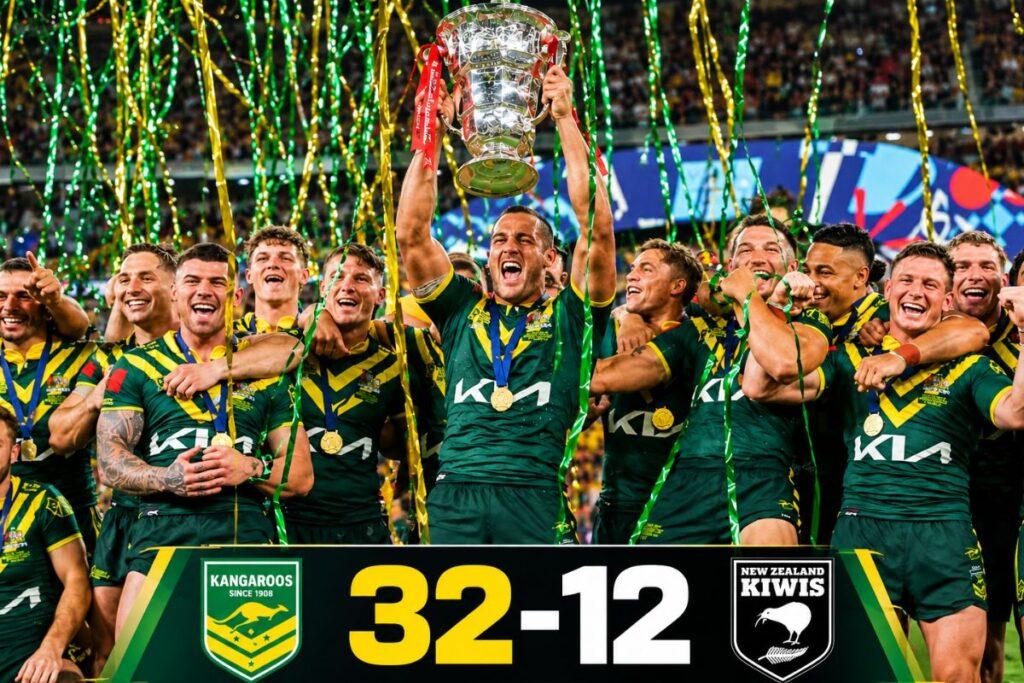
Australia won the Men’s Rugby League World Cup final, beating New Zealand 32-12 at Suncorp Stadium, Brisbane, on 15 November 2026. The Kangaroos claimed a fourth straight title and 13th overall, scoring six tries to the Kiwis’ two.
- Australia led 24-6 at half-time and never looked in danger.
- Liam Martin scored inside two minutes, the quickest try in World Cup history.
- Jack Bostock scored twice and was named Man of the Match.
- Coach Kevin Walters ended the tournament with eight wins from eight.
- The Jillaroos beat New Zealand 34-10 earlier the same day.
How The Final Unfolded
Australia hit the ground running. Martin crossed inside two minutes, after a sharp dummy-half run from Harry Grant. NRL reports it as the fastest try the tournament has seen.
The Kiwis did answer. Casey McLean scored in the 11th minute, his ninth try of the tournament, and Jamayne Isaako kicked the goal. It was 6-6.
That was as good as it got for New Zealand.
Bostock scored on 18 minutes. Then Bradman Best chased down Jahrome Hughes, forced a loose ball and scored soon after. Martin added a second just before the break, helped by Jacob Preston stripping the ball from Naufahu Whyte, according to NRL. Half-time: 24-6, per Rugby League Zone.
ALSO READ: Inside Lionel Messi International Retirement From Football: The Final Whistle
The Second Half
Tom Trbojevic made it 28-6 three minutes after the restart. A Dane Gagai error gave him the chance.
New Zealand came back into it late on. Isaiah Papali’i scored from a Kodi Nikorima grubber, and Ronaldo Mulitalo had a try ruled out for a knock-on. Then Bostock sealed it with his second, finishing off a back-hand offload from Best, as Sky Sports describes it.
Sky also notes New Zealand missed 37 tackles. Against this Australian side, that is simply too many.
The Scorecard At A Glance
| Teams | Tries | Goals | Half-time | Full-time |
|---|---|---|---|---|
| Australia | Martin 2, Bostock 2, Best, Trbojevic | Munster: 3 conversions, 1 penalty | 24 | 32 |
| New Zealand | McLean, Papali’i | Isaako: 2 conversions | 6 | 12 |
Table Source: Rugby League Zone and NRL. Official attendance was 52,461, according to NRL.
A Fourth Straight World Cup Title
This was Australia’s fourth consecutive men’s title and their 13th overall. NRL adds that they have now won 23 World Cup matches in a row.
The run is a long one. The Kangaroos also lifted the trophy in 2013, 2017 and 2021, the last of those played in England in 2022.
It was not all plain sailing this time, mind. SBS points out that the Kiwis lost the tournament opener by only two points. Australia had to be better in the final, and they were.
Rugby League Zone records coach Walters finishing with a perfect 8-0.
How This Compares With Earlier Finals
Australia’s recent finals have rarely been close. They beat New Zealand 34-2 in 2013, England 6-0 in 2017 and Samoa 30-10 in the 2021 final, played in 2022.
This one sits comfortably in that pattern. Twenty points was the winning margin, and the result was never really in doubt after half-time. Football’s version of the tournament is rarely so predictable, as Romelu Lukaku’s bid to save Belgium’s World Cup dream showed.
Where The Game Was Won
Look at the first half and the story is simple. Australia scored four tries in 37 minutes. Two came from turnovers, forced by defenders chasing and stripping the ball. Reacting that fast takes sharp footwork and balance, the kind built through agility exercises.
That is the kind of pressure Test sides struggle to live with. That level of intensity is built long before kick-off, in the way elite players and athletes train. The Kiwis’ errors handed over field position, and Australia took every bit of it.
New Zealand’s two tries were well made. They just never got enough of the ball in good areas to keep scoring.
A Farewell For Tedesco
There was a sentimental moment too. James Tedesco came off the bench for the last five minutes, after Latrell Mitchell withdrew through illness, Sky Sports reports. Late changes through illness or injury are a familiar worry in elite sport, as Arsenal fans learned with Kai Havertz’s injury.
Afterwards, he confirmed it was his final Test. “This will be my last time wearing this jersey, so it was pretty special,” he said.
Bostock, meanwhile, was lost for words. “I can’t put it into words. It’s unbelievable,” he said.
Records And A Double
Isaako had a record of his own. NRL says he passed Shaun Johnson’s Test points total for New Zealand, reaching 227.
It was a double for Australia on the day, too. The Jillaroos beat New Zealand 34-10 in the women’s final, earlier at the same ground, for their own fourth straight title. Jaime Chapman scored a hat-trick, Rugby League Zone notes.
What It Tells Us About The Sport
Australia’s depth is still the gap. Nobody else can leave out a player of Tedesco’s standing and still win comfortably.
New Zealand showed enough, particularly in attack, to suggest the gap can be closed. Cutting the errors would be the first step.
ALSO READ: Leah Williamson: The Captain Who Makes England Football Team Feel Invincible
FAQs
Q1: Who Won The Men’s Rugby League World Cup Final In 2026?
Australia beat New Zealand 32-12 on 15 November 2026.
Q2: Where Was The Final Played?
Suncorp Stadium in Brisbane, with a reported crowd of 52,461.
Q3: Who Was Man Of The Match?
Jack Bostock, who scored two tries.
Q4: How Many World Cups Have Australia Won?
Thirteen men’s titles, including four in a row.
Q5: Did The Australian Women Win Too?
Yes. The Jillaroos beat New Zealand 34-10 earlier that day.
Disclaimer: This article is published strictly for informational and news reporting purposes only and is not intended for promotion, marketing, or commercial endorsement. Readers are encouraged to independently verify all match facts, statistics, and tournament details, and to consult appropriate professional sources or sports governing bodies for further guidance.