
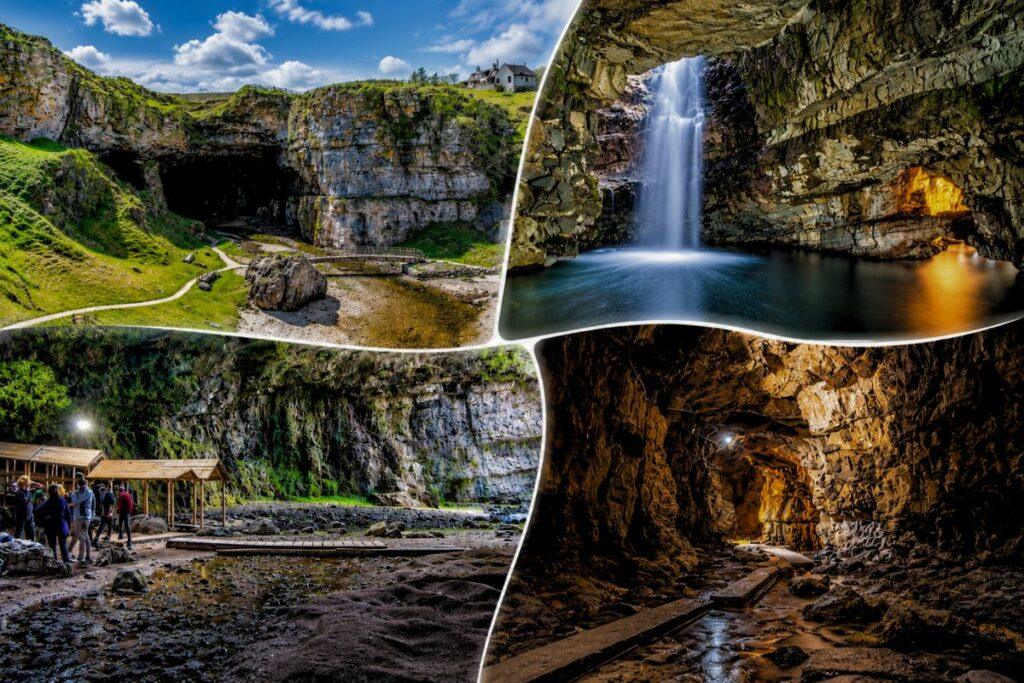
The Caves of Smoo are a combined sea and freshwater cave on the north coast of Scotland, about 2 km east of Durness. A tidal inlet leads to a vast sea-carved entrance chamber, while a stream tumbles into inner chambers shaped by rainwater.
- Smoo Cave sits roughly 2 km east of Durness in Sutherland.
- Its entrance chamber is about 40 m wide and 15 m high.
- The sea carved the first chamber. Fresh water shaped the inner ones.
- Viking-age people used the cave around the 8th to 11th centuries.
- It is a scheduled monument, with steps and walkways for visitors.
Where Is Caves Of Smoo, Exactly?
Smoo Cave lies at the eastern end of Durness, in the far north-west Highlands. The car park is just off the A838, and the cave is a short walk away, according to Undiscovered Scotland. The wild, open landscape around Durness shows why the UK countryside makes such a perfect escape.
You don’t need to be an explorer. Steps run down the western side of the cleft. A wooden footbridge crosses the stream, and a path leads into the first chamber.
It feels remote because it is. But the walk itself is easy. For anyone drawn to off-the-beaten-track travel, it is a rewarding stop that doesn’t demand serious effort.
Two Caves In One
Most caves are either carved by the sea or dissolved by fresh water. Smoo is a bit of both.
The first chamber is the sea’s work. Waves and tides hollowed out the rock over a very long time. The inner chambers are different. They were formed by rainwater slowly dissolving the stone, as Wikipedia’s Smoo Cave entry explains.
That mix is why people call it a combined sea and freshwater cave. The Scottish Geology Trust describes it as a good example of coastal erosion and dissolution working together, and as one of the largest former sea caves in Europe.
Smoo Cave At A Glance
Measurements vary a little between sources. These figures come from Wikipedia.
| Feature | Figure |
|---|---|
| Distance from Durness village | About 2 km east |
| Entrance and main chamber | About 40 m wide, 15 m high |
| Length to the end of the cave | 83 m |
| Waterfall inside the cave | About 20 m high |
| Tidal gorge leading to the cave | About 600 m long |
| Visitors each year | About 40,000 |
Table Source: Wikipedia, Smoo Cave. Other guides give slightly different dimensions, so treat them as close estimates.
How The Cave Formed
The rock here is part of the Durness Group, a band of dolomite and limestone laid down in the Early Ordovician period. That is hundreds of millions of years ago.
Limestone and dolomite dissolve in slightly acidic rainwater. The cave follows two lines of weakness in the rock, and the stream and the sea have both widened it.
The Scottish Geology Trust places the main rock in the Sangomore Formation. The sea can still reach the cave at high tide through the gorge, known as Geodha Smoo. But sea entry is now fairly rare, mostly at spring tides. That’s partly because the land has slowly risen since the last Ice Age.
ALSO READ: Longyearbyen, Norway – The World’s Northernmost City In The Arctic Region
The Stream And The Waterfall
The star of the inner cave is the Allt Smoo. This stream runs across hard, waterproof rock, then reaches the dolomite and sinks into it.
Inside the cave, it drops through an opening in the roof as a waterfall. Wikipedia puts the drop at about 20 m. Undiscovered Scotland gives roughly 60 feet, which is close.
Here’s the catch. The waterfall is often dry. It only runs when the stream’s upstream sink overflows, usually after heavy rain.
Dye tests also traced an underwater passage back about 100 m upstream. So the whole system may be at least twice as long as people once thought.
A Human Story Too
Smoo is not just a geology lesson. People have sheltered in caves and been drawn to them for as long as there have been people, and ancient cave art around the world shows just how deep that bond runs.
A 1995 excavation turned up Neolithic, Norse and Iron Age remains, though most were Viking or medieval. Finds included fish bones, shells and iron boat nails. That suggests people repaired boats in the sheltered inlet. Radiocarbon dates point to use between the 8th and 11th centuries AD.
The name is a puzzle. It may come from Old Norse, meaning a narrow cleft or hiding place. Or it may come from a Gaelic word for fine spray. Nobody is certain.
Writer Sir Walter Scott brought the cave wider attention after his 1814 voyage around northern Scotland. And local legend long held that the Devil lived inside. The cave is now a scheduled monument, so it is protected.
Visiting The Caves Of Smoo
Entry to the cave itself is free, according to Showcaves. A wooden walkway takes you into the second chamber. That is as far as you can go on foot without a boat tour.
Overhead, blowholes in the first chamber’s roof let in daylight. You can also look down on the sinkhole from a wooden bridge.
In summer, boat tours run into the inner chamber when water levels allow. Check locally before you travel. High water can stop them, and you can’t rely on a tour running. A little preparation keeps the day relaxing, and these tips for a stress-free adventure cover the basics.
A few practical points:
- Wear shoes with a good grip. Steps and walkways get wet.
- Take a waterproof layer. The cave is damp and it is the Highlands.
- The cave is not wheelchair accessible, according to Showcaves.
- Allow about 20 minutes for the self-guided walkway.
ALSO READ: Famous UK Film Locations You Can Visit
FAQs
Q1: Where Are The Caves Of Smoo?
About 2 km east of Durness, on the north coast of Sutherland in the Scottish Highlands.
Q2: Is Smoo Cave Really Both A Sea Cave And A Freshwater Cave?
Yes. The sea carved the first chamber. The inner chambers were shaped by the freshwater Allt Smoo.
Q3: How Big Is Smoo Cave?
The entrance is about 40 m wide and 15 m high. The cave runs about 83 m to its end, per Wikipedia.
Q4: Is It Free To Visit?
Entering the cave is free, according to Showcaves. Summer boat tours are separate and depend on water levels.
Q5: Is The Waterfall Always Flowing?
No. It is often dry and flows mainly when the upstream sink overflows, usually after heavy rain.
Disclaimer: This travel article is provided strictly for general informational purposes and is not intended as promotion or endorsement of any destination, tour, or service. Cave conditions, boat tour availability, and visitor access can change without notice, so readers should verify facts independently and seek professional or local guidance before planning a trip.