
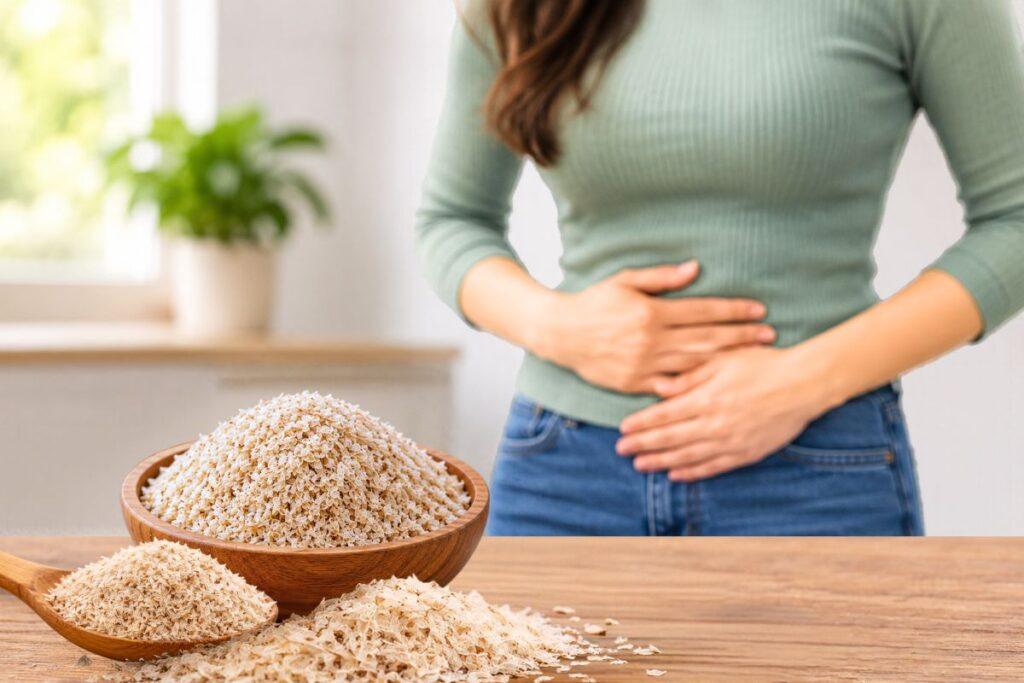
Add psyllium husk to your diet, and stools will turn softer and more regular within 24 to 72 hours. Blood sugar steadies after meals. LDL cholesterol falls over a few weeks, and hunger eases between meals. Drink plenty of water with every dose.
- A soluble fibre from the seed coat of Plantago ovata, sold in the UK as ispaghula husk and as Fybogel.
- It forms a gel in the gut, softening hard stools and firming loose ones.
- Doses of 6 to 15 g a day have lowered LDL cholesterol by 6 to 24%.
- About 10.8 g daily before meals produced 2.1 kg of average weight loss over five months.
- Never swallow it dry. Without fluid, it swells in the throat or blocks the bowel.
- Keep it two hours apart from prescription medicines.
What Is Psyllium Husk?
Psyllium husk is the outer coating of Plantago ovata seeds, an annual herb grown mainly in northern India. The husk is dried and milled into a pale powder, and milling yields about a quarter of the seed weight.
Its active part is mucilage. Wikipedia’s entry on the plant describes mucilage as a group of clear, colourless gelling agents that are derived from plants. PharmEasy notes it can expand in volume as it absorbs water up to 40 times its weight.
Isabgol is the Indian name, ispaghula husk the UK term, and blond psyllium a common label. Powder is the better buy: a teaspoon gives roughly 3.4g of fibre, a capsule only 0.4g. For comparison, a standard 30 g bowl of cornflakes delivers less than 1 g of fibre.
How Does It Work
Psyllium is almost entirely soluble fibre, and your small intestine cannot digest it. Stir it into water and it swells into a thick gel within minutes.
That gel travels the gut largely intact and works in three directions at once. It holds water, which bulks and softens stool. It thickens the contents of the small intestine, slowing how fast sugars and fats are absorbed. It traps bile acids, made mostly of cholesterol, and carries them out.
So psyllium is a bulk-forming laxative, not a stimulant one. It never forces your colon to contract. The bulk presses on the bowel wall and normal movement follows, so many clinicians call it a bowel regulator.
ALSO READ: Biotin Rich Food: Ultimate Guide To Top Sources for Healthy Hair and Nails
8 Psyllium Husk Potential Health Benefits
Constipation:
The husk pulls water into the stool and reduces straining. A 2022 review found 10 g a day for at least four weeks beats osmotic and stimulant laxatives for weekly bowel movements. A 2021 review called the effect modest but safe, and weaker than polyethylene glycol, lactulose or prunes.
Diarrhoea:
The same action runs in reverse. Dry fibre soaks up excess fluid, firms loose stools and slows colon transit. Medical News Today highlights this dual effect, which also helps people with incontinence from liquid stools. Psyllium is the only isolated fibre recommended for irritable bowel syndrome by the American College of Gastroenterology and causes less bloating than bran.
IBS:
Psyllium is the only isolated fibre recommended for irritable bowel syndrome by the American College of Gastroenterology and causes less bloating than bran. The American Gastroenterological Association backs it for chronic constipation.
Cholesterol:
A 2017 review found that taking 6 to 15 grams daily (g/d) of fibre supplements helped decrease LDL (“bad”) cholesterol by up to 24% and total cholesterol by up to 20%. Healthline ties those falls to lower heart disease and stroke risk. The US Food and Drug Administration approved a heart-health claim in 1998, requiring 1.7 g per serving. In a 2005 trial, 10 mg of simvastatin plus psyllium matched 20 mg of simvastatin alone.
Blood Sugar:
The gel slows gastric emptying, so glucose enters the blood more gently. A 2015 meta-analysis of 35 trials found psyllium before meals lowered fasting glucose by 37 mg/dl and HbA1c by 0.97% in people with type 2 diabetes. A qualified US claim followed in 2014, though regulators called the evidence very limited.
Weight And Appetite:
Research in the Journal of the American Association of Nurse Practitioners pooled six controlled trials and found 10.8 g a day before meals cut body weight by 2.1 kg, BMI by 0.8 kg/m² and waist circumference by 2.2 cm. It’s called “poor man’s Ozempic”, but that oversells it. WebMD quotes dietitian Vanessa King of the Academy of Nutrition and Dietetics, noting Ozempic is far more powerful and that psyllium’s effect shows mainly above a BMI of 30.
Gut Bacteria:
Roughly 15% of psyllium ferments, so it acts as a mild prebiotic. A 2019 trial using 21 g a day for a week raised Lachnospira, Roseburia and Faecalibacterium, all butyrate producers. Butyrate supports the gut lining and calms inflammation, and slow fermentation means far less wind than inulin.
Blood Pressure:
A 2019 meta-analysis found a drop of about 2 mmHg in people with hypertension after eight weeks.
How Much To Take And When
Start low. Half a teaspoon in a large glass of water once a day is plenty for week one, then build up over two to three weeks.
Trial doses sit between 10 and 15 g a day, split into three doses of 3.5 to 5 g before meals. For constipation, doses run from 3.5 g a day up to 11 g twice daily. In the UK, two Fybogel sachets after food is the standard adult routine for up to seven days.
Stir and drink straight away, before it thickens. Allow at least 240 ml of fluid per dose, leave an hour between your evening dose and bed, and keep drinking water. Too little fluid causes the constipation you were trying to fix.
Side Effects And Who Should Be Careful
Most people tolerate it well. The NHS reports that around 1 in 100 people get gas and bloating, which usually settles as your gut adjusts. Cramping, mild nausea and loose stools can appear early on. Plant-based remedies such as dandelion tea can also upset the stomach at first, which is another reason to start with a small amount.
Choking and bowel obstruction are both documented in people who took it dry. Allergic reactions, including anaphylaxis, happen occasionally, and staff handling the powder daily are most often sensitised.
Ask your GP first if you have a bowel obstruction, weak bowel muscle, swallowing difficulty, phenylketonuria, rectal bleeding, kidney disease, or a bowel habit that changed over two weeks ago. Carbamazepine, digoxin and mesalazine need checking; insulin doses may need adjusting, and long-term use can reduce the absorption of vitamin B12, iron, zinc, magnesium and copper.
One label check matters. In 2024, ConsumerLab tested nine psyllium supplements and found lead in all of them, four above their alert threshold. The lead comes from the soil, so choose brands publishing batch-specific testing.
Final Verdict
Most UK adults get around 20g of fibre a day against a 30g target, and this powder closes that gap at low cost. It will not transform your health alone, but it steadies your bowels, nudges cholesterol down and blunts appetite.
ALSO READ: Difference Between Diet Coke And Coke Zero: Facts Worth Knowing
FAQs
Q1: What Happens To Your Body When You Start Taking Psyllium Husk?
Stools become bulkier and softer within one to three days. Mild wind or bloating is common in week one, then settles as your gut adapts.
Q2: How Long Does Psyllium Husk Take To Work?
It usually works within 24 to 72 hours for constipation. Cholesterol benefits take about three weeks of daily use at around 10 g.
Q3: Can You Take Psyllium Husk Every Day?
Yes, daily use is safe and well tolerated when taken with enough fluid. It is considered safe for up to 20 weeks without medical review.
Q4: Does Psyllium Husk Help You Lose Weight?
It can, modestly. Taken before meals, it increases fullness and improves insulin response, with trials showing roughly 2 kg lost over five months.
Q5: Is It Better To Take Psyllium Husk In The Morning Or At Night?
There is no best time. Take it at night for a morning bowel movement, or before meals for appetite and blood sugar control.
Q6: What Should You Not Take With Psyllium Husk?
Keep it two hours away from prescription medicines, as it delays absorption. Check with your pharmacist if you take heart, epilepsy or diabetes medication.
Disclaimer: This article is published strictly for informational purposes and is not intended for product promotion. Readers should independently verify all relevant facts and seek professional medical advice before making any dietary adjustments or starting new supplement regimens.