
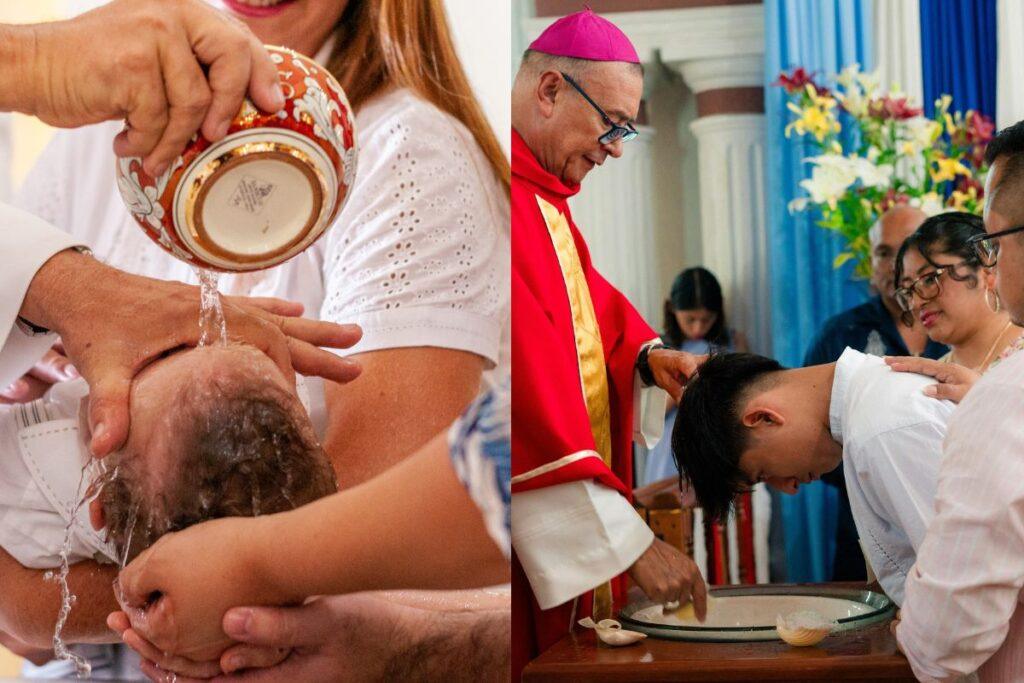
Baptism is the Christian rite of welcoming someone into the faith with water, and it can happen at any age. A christening is nearly always the baptism of a baby, with a name given and godparents chosen. So the scope is the main difference in baptism and christening.
Ask ten British parents what they’re planning for the baby, and you’ll hear both words. Nobody corrects anybody. Every christening is a baptism, but not every baptism is a christening.
- Baptism works at any age. A christening means a baby or child.
- Both use water. Both happen in church, with family watching.
- A christening normally includes the child’s name, but baptism does not necessarily involve changing or giving a new name.
- You’re only baptised once in most churches.
- “Christening” is the older English word. “Baptism” turned up later.
- Plenty of churches use both words for the same service.
What Baptism Really Means?
The word is Greek. Baptisma means immersion, or dipping in water. It’s a rite of initiation, and water is almost always involved. Most churches call it a sacrament. Some call it an ordinance instead.
The Gospels say that John the Baptist baptised Jesus in the River Jordan. Patheos makes an interesting point here: Jesus only did it to fulfil the law and to leave us an example to follow. Later came Matthew 28:19, where Jesus tells the disciples to make disciples of all nations, “baptising them in the name of the Father and of the Son and of the Holy Spirit”.
So what is it doing? It’s a public profession and an outward symbol of an inward expression of faith or trust in Christ. It stands for the death of the old self and the arrival of the “new creation in Christ”.
What Does Christening Means?
Pediaa describes a christening as a type of baptism, usually held in Catholic or Anglican churches, where a baby is officially welcomed into the faith. The child gets a Christian name. The vicar sprinkles water on the head, says prayers and blesses the child. Godparents promise to help raise them in the faith.
Bebe Couture notes the baby usually wears white christening clothes to stand for purity, innocence and new beginnings. Most families book it a few months after the birth. Ships get christened too. So do church bells, buildings, and even dolls in parts of Cornwall.
Difference In Baptism And Christening
| Point | Baptism | Christening |
|---|---|---|
What it is | A religious sacrament | A religious ceremony |
Age | Any age, baby to adult | Babies and young children |
Naming | Not always included | Always includes a name |
Godparents | Not always needed | Almost always chosen |
How often | Once in a lifetime | Once, inside the baptism |
Word used more by | Roman Catholics | Anglicans |
Table Source: Comparative analysis based on official liturgical doctrines from The Church of England and the Catechism of the Catholic Church
Parenting draws that first line out neatly: one is the sacrament, the other is the ceremony wrapped around it. It also flags a rare case where an adult is christened because they’re taking a Biblical name.
Where The Two Words Came From
Here’s the bit that surprises most people. “Christening” came first. The Oxford English Dictionary traces it back to Bede in 890. “Baptism” only shows up in Middle English, in Piers Plowman in 1377. Wycliffe’s 1382 Bible happily said Jesus was “christened” by John in the Jordan. Tyndale and the King James Bible later went with “baptism”, which is why that word feels more scriptural now.
Then class got involved. Research from the Church of England found that around 1500, women and working people said “christening”, while men, the wealthy and the educated said “baptism”. Court records prove it. At the Old Bailey, ordinary witnesses said “christening” over three quarters of the time, while the chaplain of Newgate prison used “baptism” more than 95% of the time.
Little has shifted. Britons still google “christening” far more. Americans google “baptism”. Listen to the idioms too. A “baptism of fire” is something you dread. “I christened the new house with a glass of wine” is a good night.
How The Water Is Used
Four ways, really.
- Aspersion is sprinkling water on the head.
- Affusion is pouring it over the head.
- Immersion dips part of the body.
- Submersion covers the lot.
Some traditions, particularly Eastern Orthodox churches, use three immersions in the name of the Trinity, while other churches use pouring, sprinkling or immersion in different ways. Until the Middle Ages, most people were baptised naked.
What Different Churches Actually Do
In the Latin Catholic Church, baptism may be administered by pouring water over the head or by immersion. They baptise babies, believe it wipes out original sin and all personal sins, and say it leaves a permanent mark, so it is never repeated. They also recognise baptism of blood, for martyrs, and baptism of desire, for those who die before the water.
Orthodox churches use full triple submersion. Anglicans use immersion or pouring. Baptists generally practise believer’s baptism by immersion and only for those old enough to decide for themselves. Babies get a child dedication instead.
Oneness Pentecostals baptise only in Jesus’ name. Quakers, some Unitarians and the Salvation Army skip water entirely, saying inward grace is the point.
Pediaa lists the symbols you’ll spot at a Catholic service: water for new life, oil to show the person is chosen, a candle for Christ as the light of the world, and a white garment for purity.
Can You Be Christened But Not Baptised?
In most British churches, no. The christening is the same as the baptism. Some traditions split the naming and the water, with the water coming later. If you’re unsure, ring your parish and ask how they do it.
Which One Matters More?
Honestly? Patheos puts it best: the differences between christening and baptism are insignificant as compared to what must happen before a christening or baptism. Then comes the line that sticks. “Baptism just gets you wet. Jesus gets you saved.”
Baptismal sponsors were already appearing in Christian practice by the early third century, although the modern role of godparents developed over time. That hasn’t changed in eighteen centuries. Only the word on the invitation has changed.
ALSO READ: Is UK and Great Britain the Same? Many Get It Wrong
FAQs
Q1. Is A Christening The Same As A Baptism?
Not exactly. A christening is a type of baptism, usually for a baby. Baptism is the wider term and works at any age.
Q2. Do Adults Get Christened Or Baptised?
Adults get baptised. Christening is for babies and young children in almost every British church.
Q3. How Old Should A Baby Be For A Christening?
There is no fixed age for a christening, although many families choose to have one during infancy.
Q4. Can You Be Baptised Twice?
Usually not. Most churches treat it as a one-off, but some do re-baptise adult converts.
Q5. Do You Need Godparents For A Christening?
In the Church of England, godparents are normally part of a child’s christening, with specific requirements for their number and baptismal status; other churches have different rules.
Q6. Do Muslims Have A Christening?
No. They hold a naming ceremony called Aqiqah, with prayers, a name and a family feast.
Sources & References
- Wikipedia. (2026, August). Baptism. In Wikipedia.
- Wikipedia. (2026, August). Christening. In Wikipedia.
- Pediaa. (2026). Difference between christening and baptism: Catholic and Anglican practices.
- Bebe Couture. (2026). Baby christening vs. baptism: Clothing traditions and symbolism.
- Parenting FirstCry. (2026). Baptism vs. christening: Understanding the difference.
- Church of England. (2025, November). Christenings and baptisms: Guidance for families. ChurchofEngland.org.
- U.S. Conference of Catholic Bishops. (2025, July). Sacrament of baptism: Rite and meaning. USCCB.org.
- Patheos. (2015, October 29). What is the difference between a christening and baptism?
Disclaimer: This article is provided strictly for informational and educational purposes only and is not intended for promotional purposes. Readers are advised to independently verify all facts, religious traditions, and historical information before making decisions. For personalised guidance on specific rites, ceremonies, or religious practices, please consult with qualified clergy or professional advisors.