
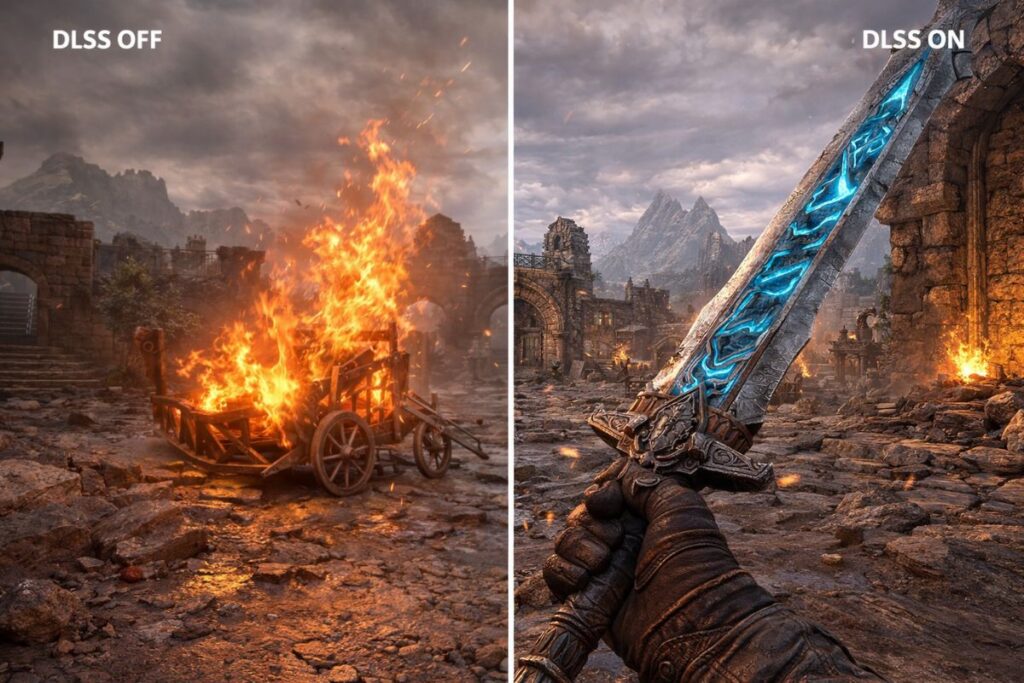
The modern gaming world has hit a massive wall. For years, the only way to get a sharper image was to shell out more money for a bigger, louder, more expensive graphics card that simply pushed more raw power. But that trial-and-error approach has hit a wall. By March 2026, the tech world has fully transitioned to a smarter, AI-influenced way of creating visuals. Which brings us on to the big question: what is deep learning super sampling and why, all of a sudden, is it the biggest tech news in the UK gaming scene?
Essentially, this technology is a sophisticated AI rendering pipeline. Instead of forcing a computer to draw every single tiny detail in high resolution—which takes ages and makes the hardware run hot enough to fry an egg—the system renders the game at a much lower, “easier” resolution. Then, a trained artificial intelligence steps in to “guess” what the high-resolution version should look like, filling in the gaps with incredible accuracy. It’s the difference between painting a massive mural by hand and using a high-tech stencil that does the heavy lifting for you.
Key Takeaways: The DLSS 2026 Snapshot
- The Big Shift: DLSS has moved from simple upscaling to “Neural Rendering” with the recent reveal of DLSS 5 at GTC 2026.
- Performance Gains: New versions can now support up to 6x frame generation, meaning the AI creates five frames for every one “real” frame rendered by the GPU.
- Ray Reconstruction: Newer generations replace old, messy “denoisers” with AI that understands how light and reflections should behave.
- The Controversy: Critics in the community have referred to some AI enhancements as “slop-tracing,” and there is a debate about artistic intent versus AI “beautification.”
- Hardware Baseline: AI rendering is no longer a nice-to-have; it’s becoming the new baseline for playing modern titles at high settings.
What Is Deep Learning Super Sampling Today?
To understand what is deep learning supersampling; it helps if we take a look at how much it has changed in the last few years. Originally, it was simply a trick to take a 1080p image and make it look like a 4K one. It worked, but occasionally, it looked a little bit cloudy around the edges. Jump to early 2026 and we enter a very different world of “neural rendering”.
In NVIDIA’s latest announcements, it’s clear that the tech is no longer merely tacking on some pixels. It’s actually “generating” the game look. So if you’re playing a character in a dark, rainy alleyway, the AI isn’t simply sharpening up the raindrops. It’s using its massive training library to decide how the neon lights should realistically bounce off those individual droplets. It’s effectively “painting” over the game in real-time with photorealistic details that the original hardware isn’t even powerful enough to calculate on its own.
The Three Pillars Of Modern Rendering
The current version of this technology isn’t just one single tool. It’s more like a three-man team working inside your PC to keep things smooth.
- Super Resolution: This is the grandfather of the group. It renders the game at a lower resolution to save power and then upscales it. It keeps your frame rates high without making the game look like a muddy mess.
- Frame Generation: This is where things get spooky. The AI looks at two consecutive frames and literally “invents” a new one to slot in between them. By January 2026, DLSS 4.5 pushed this further, allowing for a 6x multiplier. Your eyes see a buttery smooth 120 frames per second, even though your computer is only technically “rendering” 20 of them.
- Ray Reconstruction: This part specifically deals with light. Traditional methods often leave a weird “shimmering” or “noise” on shiny surfaces. The AI now knows what a reflection should look like and cleans it up instantly.
The “Slop-Tracing” Debate: Tech Vs. Art
Nothing this big comes without a bit of a row. Recently, the UK gaming community on platforms like Reddit and Digital Foundry has been split over something called “slop-tracing.” The argument is that the AI is getting too good at generating its own visuals.
Some players began to notice how the AI started “yassifying” characters—smoothing out skin textures or altering facial features to become “perfect” based on its training data. It’s like if someone added a really heavy Instagram filter over the top of a brilliant painting. Developers are now having to find a balance between using AI to boost performance and making sure the AI doesn’t accidentally rewrite the artistic vision of the game.
ALSO READ: How Generative AI Is Transforming KYC Identity Verification You Can Trust
Hardware Requirements And The 2026 GPU Ceiling
There’s a bit of a catch to all this magic. While the AI saves the GPU from doing traditional rendering work, the AI itself needs a specific brain to run on. Early demos of the upcoming DLSS 5 shown at GTC 2026 reportedly required massive amounts of power. Some XDA Developers reports suggest that to see the full “Neural Rendering” effect, we might be looking at systems that need dedicated AI inference chips just to keep up.
Anyway, for the average gamer in the UK, this tech has become a lifeline. Without it, the latest blockbuster games would barely crawl along on even a decent mid-range rig. It’s essentially a “free” performance boost that allows a card from three years ago to keep up with the demands of today’s ultra-realistic environments.
Frequently Asked Questions
Q1. Does DLSS Make The Game Look Worse?
In the early days, yes, you’d see some ghosting or blur. But in 2026? Most people find it actually looks better than native resolution because the AI is so good at cleaning up edges and lighting that traditional rendering methods miss.
Q2. Can I Use This On Any Graphics Card?
Unfortunately, no. Because it relies on specific “Tensor Cores” (the AI bits of the chip), it’s locked to NVIDIA hardware. AMD and Intel have their own versions, but they work slightly differently.
Q3. Is AI Rendering Just A Crutch For Lazy Game Developers?
That’s the million-pound question. Some say it lets devs skip the hard work of optimising their games. Others argue it’s the only way we’ll ever reach true photorealism because hardware power just can’t grow fast enough to do it “the old way.”
Q4. What Is Deep Learning Super Sampling Going To Look Like In Two Years?
By 2028, we’ll likely see AI that doesn’t just upscale, but actually generates entire environments based on a few simple shapes. We’re moving toward a world where the GPU acts more like a director and the AI acts like the entire film crew.
Looking Ahead: The New Rendering Standard
Look, the reality of March 2026 is that the line between “rendered” and “generated” has officially blurred. Whether we like it or not, the future of gaming isn’t in raw pixel counts but in the intelligence behind those pixels. We’ve reached a point where a “guess” from a well-trained AI is often more visually convincing than a “fact” calculated by a traditional engine.
This gear shift means that for anyone building a PC or buying a laptop today, checking for AI support is just as important as checking the RAM. It’s a bit of a head-spinner to think that your graphics card is essentially a miniature supercomputer making artistic choices, but that’s where we are. If you want to stay on the right side of the performance curve, keeping an eye on how these neural models evolve is going to be the difference between a smooth 4K experience and a slideshow.
In the end, it’s a massive shift in how we think about “reality” on a screen. If you’re looking to upgrade, just make sure you’re buying a card that has the AI chops to keep up with the 2026 standard.
Sources & References
NVIDIA. (2026, March). Official DLSS 5 reveal and neural rendering technical specifications from GTC 2026. NVIDIA Newsroom.
- PCMag. (2026, March). Hands-on with DLSS 5 at GTC 2026: Dual-GPU inference requirements in developer demos. PCMag Industry Report.
- XDA Developers. (2026, January). NVIDIA’s 6x frame generation proves hardware ceiling for GPUs: Impact on latency and performance.
- Digital Foundry. (2026). Technical analysis of DLSS 5: Face-swapping, ray reconstruction, and the “slop-tracing” debate.
- Tom’s Hardware. (2026). GPU ceiling debate: How AI rendering is replacing brute-force hardware power in modern game development.
Supermicro. (2026). Deep learning super sampling: Evolution from 2018 to multi-layered AI pipelines. Supermicro Technology Glossary.
Disclaimer: This article is intended for informational purposes only and does not constitute professional or technical advice. The content is based on publicly available information and general industry trends. It does not promote or endorse any specific product, brand, or service. Readers are advised to conduct their own research before making any decisions.





I learned something new today. Your writing made it simple and enjoyable.