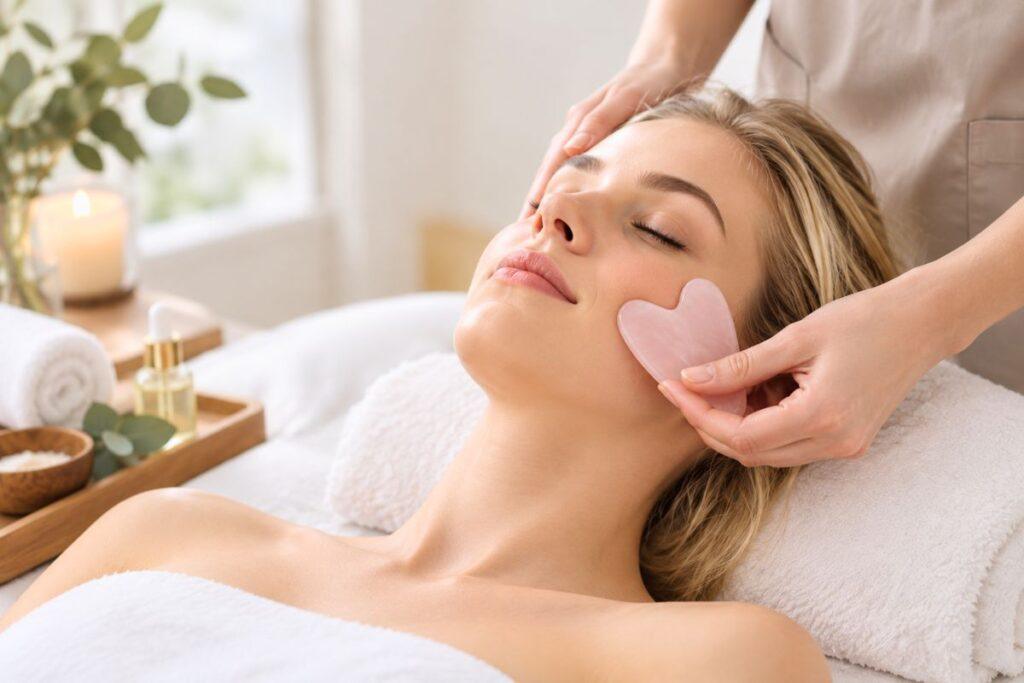
Gua sha massage is a centuries-old Chinese technique where you sweep a smooth, flat tool over oiled skin. Go gently on the face, and it can loosen tight muscles, improve circulation, and reduce puffiness.
- Gua Sha has been used in China for over 2,000 years.
- The face needs less pressure than the back.
- There are few promising studies on it that show it improves blood flow and provides short-term pain relief.
- Two or three sessions a week is enough.
- Avoid if you take blood thinners, are pregnant or have had Botox recently.
What Is Gua Sha Massage?
Gua sha (said “gwah-shah”) is a form of tool-assisted massage. A smooth, rounded tool is stroked across oiled skin in one direction. The Chinese term 刮痧 means “scraping sha”. ‘Sha’ refers to the tiny red or purple dots, called petechiae, that can appear on the body afterwards.
In traditional Chinese medicine, health depends on qi (energy) flowing freely, and gua sha is thought to release “stuck” qi. Western medicine doesn’t share this view, but it does accept that the strokes can boost blood flow. It is also called ‘coining’ or ‘spooning’ in Kerikan in Indonesia and ‘Cao gio’ in Vietnam.
ALSO READ: How the Rise of the Biohacking Spa is Redefining British Wellness in 2026
A Brief History Of Gua Sha
Before gua sha was an Instagram darling, it was a lifesaver. The earliest mention is usually traced to the Shang Han Lun, a Chinese medical text from around 220 CE.
Speaking to Vogue, acupuncturist Ping Zhang said that people first used it for heatstroke and seasonal illnesses like colds. In the Yuan Dynasty, farmers who collapsed in the blazing sun were revived with a coin, a spoon, a bone or a horn.
And what about those stories of ancient princesses scraping their way to flawless skin? Zhang said, “Well, that is false. It’s marketing.” The facial version arrived much later, almost by accident, when acupuncturists noticed their patients’ skin looking rather good.
Gua Sha Facial Massage Vs Body Gua Sha
| Feature | Facial gua sha | Body gua sha |
|---|---|---|
Pressure | Light, feather-like | Medium to firm |
Marks | Slight pinkness only | Petechiae or mild bruising |
Areas | Jaw, cheeks, brows, forehead, neck | Back, shoulders, arms, legs |
Best done | At home, once learnt | By a trained practitioner first |
Table Source: Compiled from Traditional Chinese Medicine (TCM) clinical protocols and dermatological practice standards for facial and body Gua Sha therapy.
Physios and chiropractors use the Graston technique. Founder David Graston modelled it on gua sha, then added steel tools, stretching, strengthening and ice, and dropped the qi talk.
Gua Sha Massage Benefits
Research is still limited, and some effects may be placebo. But a few results are impossible to ignore.
Cleveland Clinic says gua sha can boost microcirculation, meaning blood moves more easily through your smallest vessels. A 2011 study of 48 adults with neck pain found one week of gua sha beat heat pads for pain and movement. A 2017 study of 12 older adults with lower back pain hinted its relief lasted longer than moist heat.
For puffiness, gentle strokes may help shift lymph fluid, though it’s unproven but it’s relaxing. Researchers have also poked at migraines, perimenopause, breast engorgement, diabetes nerve pain and Parkinson’s, where a 2024 trial reported less pain and better sleep. Collagen and wrinkle claims? Mostly an anecdote.
Still, Dr Barbara Kubicka, dermatologist and director of London’s Clinicbe, is a fan: “Immediately, most people notice a reduction in puffiness, brighter skin tone, and a more sculpted appearance, particularly around the cheekbones and jawline.” The catch is that it fades.
How To Do A Gua Sha Facial Massage
Wash your hands and scrub the tool with mild soap and warm water. Then smooth on a face oil (jojoba or rosehip) so the stone glides rather than drags. Acne-prone or sensitive? Swap to an oil-free serum.
Hold the tool almost flat against your skin, somewhere between 15 and 45 degrees. Sweep from your collarbone up to your earlobe three to five times each side. Then run the notched edge along your jaw, chin to ear.
For cheeks, use the long edge and glide from beside your nose to your ear, hugging the cheekbone. Under the eyes, you should barely press at all; just skim outwards to the temple. Finish by dragging the notch from mid-brow to hairline, then sweeping up the forehead.
Golden rule: Always centre outwards, in one direction. Rubbing back and forth stretches and irritates the skin. Healthline suggests keeping the pressure light until you know how your skin reacts. Puffy morning? Chuck the stone in the fridge.
Choosing Your Gua Sha Tool
Most facial tools have a double notch for chin, jaw and brows, plus a long edge for cheeks and forehead. Jade feels cool and smooth. Rose quartz is kinder to reactive skin. Bian stone can be warmed, and steel is easy to clean. Skint is a small wooden spoon that works too.
How Often Should You Do Gua Sha Massage?
Most experts reckon two to three times a week. In an interview with Byrdie, aesthetician Ali Tobia said daily sessions give the best results once you’ve got the technique. Five gentle minutes with your morning cuppa is perfect.
ALSO READ: How Root Of Burdock Helps With Skin, Gut, And Daily Health
Side Effects And Who Should Avoid It
Gua sha is generally safe. WebMD points out that body sessions can leave bruising, discolouration or tenderness that clears up in three to four days. Infection is rare, but a grubby tool won’t help.
Skip it, or check with your GP first if you’re on blood thinners, have a clotting disorder, diabetes or circulation problems, are pregnant or are having chemotherapy. Keep it off eczema, psoriasis, rosacea, sunburn or broken skin, and wait four weeks after Botox or fillers.
And if it hurts? Stop. Acupuncturist Tim Sobo puts it plainly: “If you’re in pain, you’re not getting a beneficial treatment.” Fancy a proper body session? The British Acupuncture Council can point you to a qualified practitioner.
FAQs
Q1. Does Gua Sha Massage Actually Work?
For short-term puffiness and tension, yes, it can help. Lasting changes need regular use.
Q2. Should Gua Sha Leave Marks On My Face?
No. A pink flush is normal. If there are bruises, it means you’re pressing way too hard.
Q3. Can Gua Sha Get Rid Of A Double Chin?
Sadly not. It can’t shift fat, but it may de-puff the jaw.
Q4. When’s The Best Time To Gua Sha?
Whenever it suits you. However, mornings tackle puffiness, and evenings help you wind down.
Q5. Do I Need Oil For Gua Sha?
Yes. Oil or serum lets the stone glide instead of tugging your skin.
Q6. Is Gua Sha OK For Sensitive Skin?
Usually, with a feather-light touch. Skip it during eczema, rosacea or psoriasis flare-ups.
Sources & References
- Cleveland Clinic. (2026). Why gua sha might be good for you: Benefits, circulation, and wellness applications.
- Healthline. (2026). Gua sha: Benefits, risks, and how to use it safely.
- WebMD. (2026). What is gua sha? Uses, side effects, and recovery.
- Vogue. (2023). The history of gua sha and its role in at‑home self‑care.
Disclaimer: The content provided in this article is for educational and informational purposes only and is not intended as health or medical advice, nor is it meant for promotional endorsement. Readers should independently verify all facts and seek professional advice from a qualified healthcare practitioner before undertaking any treatment.