
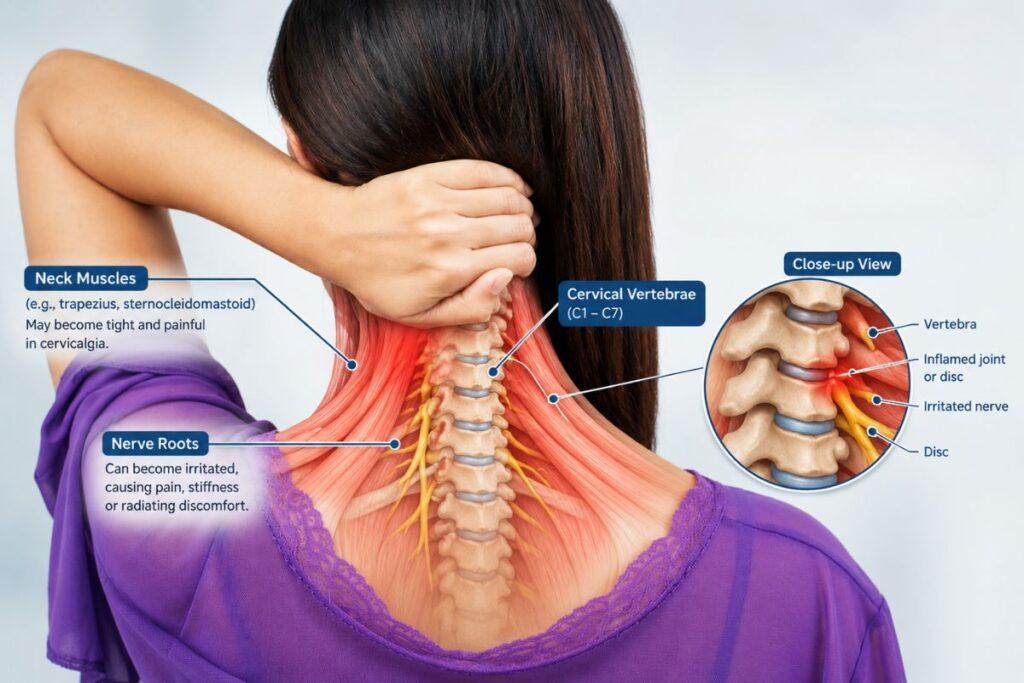
‘Cervicalgia’ is a medical word for neck pain — pain in or around your neck that doesn’t shoot down your arms. Bad posture, strain, stress or old wear and tear can cause it. Ice, heat, a gentle stretch and paracetamol clear most cases within a fortnight.
- It means pain in or around the cervical spine, the top of your spine, right under your skull.
- It affects 10% to 20% of adults. Women more than men. Odds climb with age.
- Two-thirds of us get neck pain at some point.
- Most cases are mild. A week or two and it’s gone.
- If you have fever, arm weakness, numbness, or pain after a crash, consult a doctor.
What Is Cervicalgia?
Cleveland Clinic describes cervicalgia as pain in or around the spine beneath your head. The nape, both sides of the neck, and upper vertebrae.
Bones, discs, nerves, muscles, ligaments, and tendons all protect your spinal cord, support your head, and allow you to check your blind spot. It is also fragile. It’s under pressure every waking hour, so a slow grind and one sharp jolt both do damage.
It has two patterns. Axial pain stays in the neck. Radicular pain goes into the shoulders and arms. Medical News Today points out the cervicalgia tag gets used when pain stays local and doesn’t spread to the arms or lower back.
ALSO READ: Gua Sha Massage: A Natural Way To Ease Facial Skin Tension
Types And Duration Of Neck Pain
| Type | What Happens | How Long |
|---|---|---|
Acute | Sudden, after a strain or injury | Days up to six weeks |
Subacute | Still grumbling past the early stage | Six weeks to three months |
Chronic | Injury’s healed. Pain hasn’t gone | Three months plus |
Mechanical | Muscles, tendons, ligaments | Worse with effort, better at rest |
Inflammatory | Inflammation, infection or a tumour | Constant; only treatment eases it |
Table Source: Categorisation aligned with clinical pain management guidelines from the National Institute of Arthritis and Musculoskeletal and Skin Diseases (NIAMS) and NHS UK
Columna lists a few more names. A stiff neck is a unilateral contracture of the cervical muscles that drags your head to one side. Cervicobrachial neuralgia runs from the neck to the arms and is known as sciatica of the arm. Whiplash, or cervical sprain, is a forced neck movement, usually from a car shunt.
ALSO READ: Mental Health Benefits That Could Change Your Daily Life
What Causes Cervicalgia?
Nine times out of ten it’s soft tissue damage. Either a knock or years of quiet wear.
- Posture — desk hunching, phone-neck, a screen sat too low
- Sleeping badly — hours at an awkward angle, or a useless pillow
- Injury — whiplash from a crash or contact sport, wrecking muscles, ligaments, discs and nerve roots
- Stress — you clench neck and shoulders when wound up. Nobody notices until it hurts
- Ageing — osteoarthritis, spinal stenosis, disc degeneration, herniated discs, pinched nerves, osteoporosis
- Growths — tumours, cysts and bone spurs pressing on nerves
- Illness — meningitis, rheumatoid arthritis, ankylosing spondylitis, spinal infection, cancer
- Kyphosis — cycling or a chest-heavy gym plan rounds your shoulders forward and loads the neck
That gym bag on one shoulder can cause cervicalgia too. So are weak stomach muscles, extra weight and poor eyesight, since squinting drags your head forward.
Cervicalgia Symptoms To Watch For
It depends on the damage, but most people get mild discomfort.
- Pain that stabs, burns, or dully refuses to leave
- Stiffness, spasms, a neck that won’t turn
- Headaches and sore shoulders
- Dizziness, nausea or ringing ears
- Numbness, tingling or weakness in arms and fingers
- Chest or upper back ache, sometimes blurred vision
- Losing bowel or bladder control, in bad cases
If ringing or a feeling of pressure in the ears lingers alongside the neck pain rather than easing off, it’s worth checking whether everyday noise exposure is a separate contributing factor — simple, family-friendly ways to protect hearing from everyday noise can help stop the two problems compounding each other.
How It Is Diagnosed
Your general physician asks when it started and how rough it feels. Then comes the poking: posture, alignment, tender spots, how far you can turn, and nerve function in arms and legs.
Scans only if something looks off. X-rays catch fractures, slipped discs and arthritis. An MRI shows the spinal cord, nerves, soft tissue, cysts and tumours. A CT scan stands in when there’s no MRI. Nerve conduction studies and blood tests are rarely done.
Cervicalgia Treatment Options
Again, it depends on what caused it. Ideally, most fixing happens on your sofa.
- Ice packs, 15 to 20 minutes, a few times a day, to settle inflammation
- Heat next — hot shower, warm towel, heating pad — to unknot tight muscles
- Paracetamol or ibuprofen for pain and swelling
- Stretching, gently, and only when it feels alright
- A massage to shift the blood around
- A collar to hold your head up
- Rest, and knock the offending activity on the head
Ohio State Wexner Medical Centre states that consistency beats intensity in this neck pain.
Still stuck? The list gets longer. Muscle relaxants, physiotherapy, TENS units, steroid injections, acupuncture, chiropractic care, and osteopathy. Cervical traction takes pressure off the nerves. Surgery — discectomy, fusion, disc replacement — is the last stop, kept for herniated discs, stenosis or nerve compression risking paralysis.
When To See A Doctor
Book in if the pain started with a car accident, comes with fever, chills or weight loss you can’t explain, or nags whether you’re moving or lying still. Ditto numbness or weakness in arms or legs, clumsy coordination, bowel or bladder changes, painkillers doing nothing, or a week gone with no improvement. If you wait for Cervicalgia treatment, it will drag out recovery.
Preventing Cervicalgia
Instituto Clavel reckons the fix starts at your desk: monitor at eye level, knees at 90 degrees, feet flat on the floor. Sleep on your back or side, never face down with your head twisted. Use a pillow that keeps your neck in line, and stick one between your knees if you’re a side sleeper.
Then the easy stuff. Move about. Bin the heavy shoulder bag. Burn off stress with yoga, Pilates or breathing exercises. Smoking wrecks bone and slows healing, so there’s another reason to pack it in.
For your upper back: ten scapular squeezes, ten doorframe push-ups, and ten Theraband rows.
ALSO READ: Top Exercises for Agility: The Ultimate Multi-Directional Training Plan
FAQs
Q1. What Is Cervicalgia In Simple Terms?
It’s the medical name for neck pain in the cervical spine. The pain stays in the neck and doesn’t run down your arms.
Q2. How Long Does Cervicalgia Last?
One to two weeks for acute cases. Chronic cervicalgia hangs on three months or more and needs a proper look.
Q3. Is Cervicalgia Serious?
Usually not. Occasionally it flags something bigger, like a spinal infection or trapped nerve, so lasting pain needs a check.
Q4. Which Is The Best Sleeping Position For A Sore Neck?
Back or side, with a pillow that keeps your neck aligned. Never lie face down with your head turned.
Q5. Can Stress Really Cause Neck Pain?
Yes. You tense your neck and shoulders without noticing, and that clenching turns into pain.
Q6. Should I Use Heat Or Ice For Neck Pain?
Ice first, right after an injury, to bring swelling down. Heat later, to loosen muscles and get blood moving.
Sources & References
- Mayo Clinic. (2026, May 13). Neck pain – Symptoms and causes. MayoClinic.org.
- Wikipedia. (2026). Cervicalgia. In Wikipedia.
- American Association of Neurological Surgeons. (2025, April 29). Neck pain: Neurosurgical conditions and treatments. AANS.org.
- Cleveland Clinic. (2022, December 9). Neck pain: 6 common causes and treatments. ClevelandClinic.org.
Disclaimer: The information provided in this article is for educational and general informational purposes only and is not intended for commercial promotion or as direct medical advice. This content should not replace professional medical evaluation, diagnosis, or treatment. Readers should independently verify all facts and seek professional advice from a qualified healthcare provider before making medical decisions.