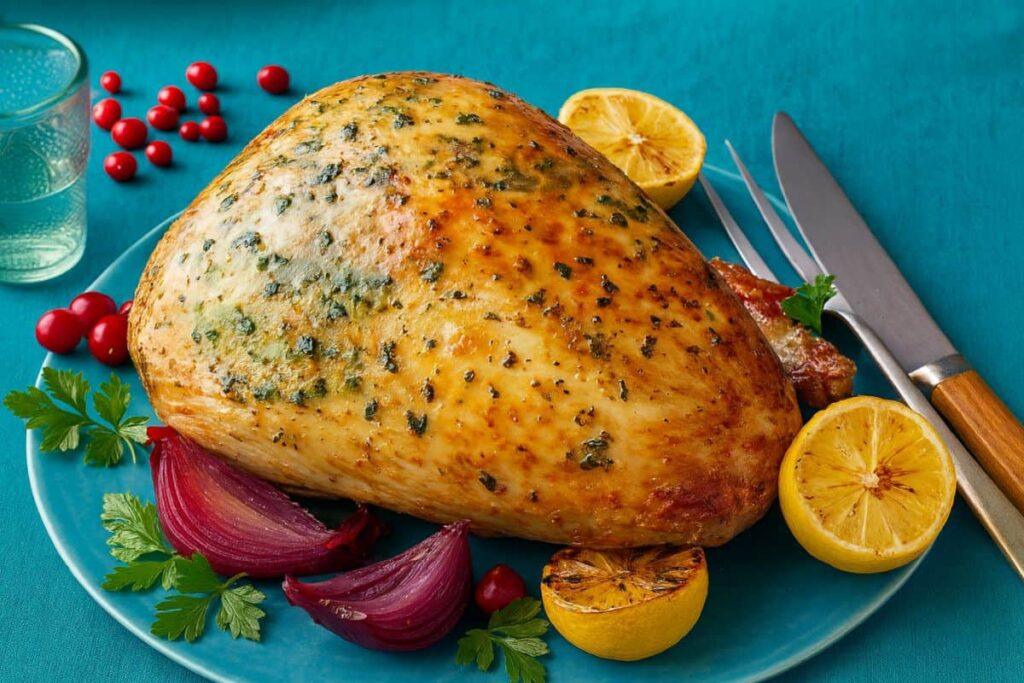
Christmas is coming, and you have got yourself a turkey crown instead of the full bird. Smart move. Less faff, less waste, easier to carve. But now you’re left pondering how long to cook a turkey crown without turning it into shoe leather.
Fair question. Turkey has a bad reputation for being dry because people constantly overcook it. Let me walk you through this Christmas meal.
How Long To Cook A Turkey Crown – The Basic Numbers
For a crown of less than 4 kg, you need to cook it for 20 minutes per kg and then add another 70 minutes. Over 4 kg? Still 20 minutes per kg, but add another 90 minutes.
So a 2 kg turkey crown? That’s 40 minutes for the weight, plus 70 minutes. The total is one hour and 50 minutes. For safety’s sake, round it up to two hours.
For a 3 kg turkey crown cooking time, this is your rule of thumb: -60 minutes for the weight, then plus 70 minutes. That gives you 2 hours and 10 minutes. Tack on 10 more minutes for good measure.
Your oven needs to be at 180°C for a fan oven or 190 °C if it’s conventional.
When It’s Boneless
The cooking time for a boneless turkey crown is not the same, as it doesn’t have a bone to conduct heat through its middle. If you have a boneless crown, it will take approximately 55 minutes per kg, plus an additional 25 minutes.
What would be the cooking time for a 2 kg boneless crown? That is 110 minutes for the weight and 25 minutes more. Say 2 hours 15 minutes total. With no bone there, the heat has to work harder to come through.
Some butchers wrap boneless crowns in bacon, and that’s a good way to keep things moist. If yours doesn’t come like that, lay some streaky bacon over the top yourself.
ALSO READ: Who Is The Richest Chef In The World? A Hawaiian Chef Beat Everyone In Top 5
The Foil Trick
Begin with the crown loosely wrapped with aluminium foil. This will trap the moisture and prevent the skin from browning too fast.
After 30 minutes of cooking, remove the foil, then crank up the temperature to 200°C so that the skin crisps without overcooking the meat.
Occasionally, baste the turkey with the juices from the tin. Throw those juices right over the top. Three or four times in the middle of cooking is sufficient.
Checking It’s Done
Cooking times are guidelines, not gospel. Your oven might run hot or cold. You might’ve opened the door, checking the roast potatoes. All of this affects timing.
Stick a skewer into the thickest part of the breast. The juices should run clear, not pink. If they’re pink, they need longer.
Better yet, use a meat thermometer. Stick it in the thickest bit, and you want 65°C minimum. Some people go for 70°C to be extra safe.
Let It Rest
After your crown has cooked, don’t carve right away. Remove it from the oven, loosely cover with foil and a tea towel, and let it rest for at least 20 minutes. Half an hour’s even better.
As meat cooks, all the juices move to its surface. If you carve straightaway, those juices run everywhere onto your board rather than staying in the meat. Allow to rest, and they will redistribute back through the turkey.
If you need to use the oven for other things, you can leave a crown resting for up to two hours. It will stay warm beneath that foil and towel.
ALSO READ: How Much Does a Personal Chef Cost? A Quick Helpful Guide For You
Turkey Crown Cooking Time Per Kg Breakdown
A 1.5 kg crown takes about 1 hour and 40 minutes. A 2 kg crown needs roughly 2 hours. For 2.5 kg, you’re looking at 2 hours and 20 minutes. A 3 kg crown takes 2 hours 40 minutes. A 4 kg crown needs 3 hours and 10 minutes.
These instructions are for cooking bone-in crowns at a temperature range of 180°C to 190°C. Always check with a thermometer because your oven might have other ideas.
Don’t Do These Things To Stuffed Turkey Crown
- The first mistake is not defrosting properly. If you’ve bought frozen, it needs at least 12 hours per kg to defrost in the fridge. A two-kg crown needs a full day.
- The second mistake is not bringing it to room temperature before cooking. Take your crown out of the fridge an hour before it goes in the oven. Cold meat straight from the fridge messes up your timings.
- The third mistake is washing the turkey. Don’t. Turkey can carry bacteria, and washing it just spreads that bacteria around your kitchen. Modern turkeys are oven-ready. If yours isn’t, just wipe it with kitchen paper.
- The fourth mistake is stuffing it too full. If you’re putting stuffing in the neck cavity, don’t pack it tight. Use a maximum of 10% of the bird’s weight in stuffing.
Keep It Moist
Turkey breast is lean meat. Great for your waistline, not so great for keeping it moist during cooking.
Slather softened butter under the skin before cooking. Get your fingers in there and spread it about. You can mix herbs into the butter, too. Or just lay bacon rashers over the top.
ALSO READ: Lorna McNee Partner Dawn McIntyre And Their Great Life Beyond The Chef’s Kitchen
Make Gravy From The Juices
Once your crown’s cooked and resting, don’t chuck away those juices in the roasting tin. Pour them into a jug, let the fat rise to the top, then skim most of it off.
Add those juices to your gravy along with some stock. If you put vegetables under the crown whilst it cooks, mash them up a bit, add some flour to thicken, and you’ve got proper gravy.
Final Checks
When you reckon it’s done, do these checks. Juices running clear when you stick a skewer in? Good. Internal temperature at 65°C or above? Brilliant. Has it rested for at least 20 minutes? Excellent. Now you can carve.
Carve across the grain in thin slices. A 2 kg crown feeds about six people, maybe eight if you’ve got loads of sides. A 3 kg crown feeds eight to ten people.
Store any leftovers in the refrigerator within two hours of cooking. They’ll keep for three days.
So there you go. Go by the 20 minutes per kg plus 70 minutes rule for bone-in crowns that are under around 4 kg, check they’re actually cooked with a thermometer, and rest them properly. Do that, and you’re eating a beautiful, moist turkey instead of something you have to cover in gravy just to gobble down.
Not exactly complicated. It just requires a bit of forethought and some plain old common sense. Your Christmas dinner’s sorted.
Disclaimer: This article is provided for informational purposes only. While reasonable efforts have been made to ensure the accuracy and reliability of the information presented, no guarantee is made regarding its completeness, accuracy, or timeliness. The content does not constitute any specialised advice and should not be relied upon as such. Readers are encouraged to conduct their own research and consult qualified professionals before making any decisions based on the information contained in this article.