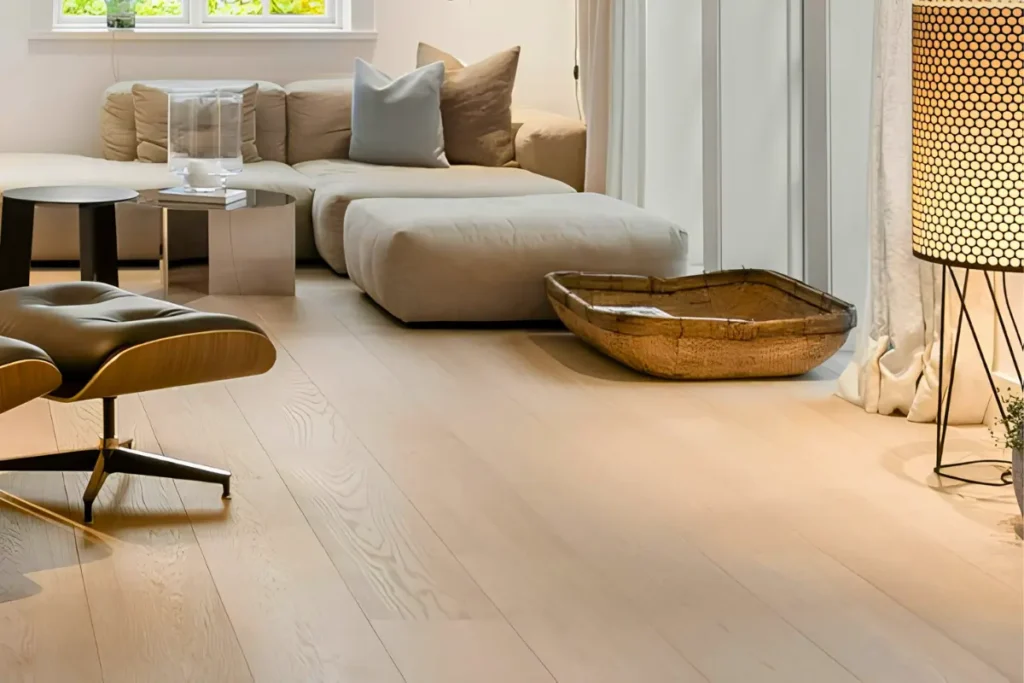
Wide oak boards are returning as a calmer answer to narrow flooring defaults. It turns out that squeezing skinny strips of wood into our living spaces was just making our homes feel frantic. By rolling out a generous wide plank instead, rooms instantly breathe a sigh of relief, trading busy clutter for a sense of grounded, architectural ease.
London’s Narrow-Floor Default Is Being Retired
For two decades, the default floor in a London home was narrow strip flooring: mid-width oak boards, the standard 140mm or thereabouts, laid by builders and rarely questioned. In 2026, that default is quietly being retired. Wide plank engineered oak flooring, with boards up to 300mm wide, has returned to London design. In many renovations, restorations and conversions, the floor beneath you is wider than it was a decade ago.
The Wider-Board Trend Has Been Building For Five Years
Houzz UK renovation reporting, Pinterest Predicts and interiors coverage from House & Garden and ELLE Decoration have pointed towards warmer, more natural homes. Across residential renovations, period restorations, hospitality fit-outs and contemporary new-builds, wider oak boards have become part of that shift.
For London flooring specialists, the change has been clear. Waxed Floors, a Battersea-based specialist in wide plank engineered oak flooring with a Battersea Rise showroom, has seen enquiries move towards wider boards. Founder Christof Schirlbauer says what was once treated as a premium specification is now an expectation among design-conscious London homeowners.
Why Wider Boards Make London Rooms Feel Calmer
The appeal starts with fewer lines. Boards in the 180mm to 300mm range are increasingly replacing the narrower 140mm to 160mm strips common in 2000s and 2010s refurbishments. Fewer seams create a calmer surface, making rooms feel more open and less visually busy.
Oak needs room to show itself. Cathedrals, knots and tonal variation read more clearly across a 220mm or 260mm board than across a narrow strip. In compact London flats, this can be counterintuitive but useful.
In period homes, wider planks can sit closer to Georgian, Victorian and Edwardian proportions. Open-plan kitchen-diners, knocked-through reception rooms and family spaces benefit from continuous flooring across longer spans. The move away from pale, narrow, uniform oak has brought warmer tones, visible texture and oil-finished floors that feel more tactile underfoot. On camera, wide planks read clearly too, explaining their presence in interior features, social feeds and short-let photography.
ALSO READ: How Restored Flooring Changes the Feel of a Room
What Is Actually Being Fitted Underfoot
In design-led London projects, the width range is 180 mm to 300 mm, with 220 mm to 260 mm often the middle ground. Longer boards, often 2000mm or more, support the same continuous-surface logic.
Rustic grades, with knots, cathedrals and character, are popular in period homes and warmer interiors. Premier grades, cleaner and more uniform, suit contemporary flats, new-builds and minimalist schemes designed around modern interior principles..
Natural oil finishes have become a favourite over glossier lacquered surfaces for many projects, as they keep timber tactile and allow it to age with depth. Lightly brushed neutrals suit bright reception rooms, while smoked and fumed shades work in darker spaces.
Engineered boards usually combine a multi-layer plywood base with a solid oak top, giving wide planks better stability than traditional wide solid boards in centrally heated and underfloor-heated homes. Micro-bevelled and square edges are both used, depending on whether the room suits a defined board or a cleaner finish.
The Homes Where Wide Planks Work Hardest
Wide planks work hardest when the floor has to hold more than one part of a home together. Open-plan kitchen-diners, side-return extensions and knocked-through reception rooms benefit from a surface that does not break the room into strips.
They also suit long London hallways and conversion flats, from mansion block apartments to warehouse-style homes. In children’s bedrooms and family rooms, characterful oak can be forgiving where daily life is not always polite to pale minimalist flooring. Hospitality and short-let homes are another fit, because wider boards photograph well and age with character.
The Expert View From Battersea
“Customers are much more confident about wider boards now,” says Christof Schirlbauer, founder of Waxed Floors. “A few years ago, people saw them as a premium choice for large houses. Today, we see them requested for terraces, flats, extensions and restoration projects.”
He says scale is the biggest misunderstanding. “People assume wide planks only work in big rooms, but smaller London rooms can benefit even more. Fewer seams mean less visual clutter and a better sense of flow.”
“Engineered construction has made wider boards practical in homes where solid wide boards would have been difficult 15 years ago. With central heating and underfloor heating now part of many projects, stability is the point. Customers are also asking for natural oil finishes, characterful grades and warmer tones, especially in period London homes where proportion matters.”
The Practical Checks Before Installation
Wide planks reward good preparation and expose shortcuts. The subfloor needs to be level, dry and suitable before installation. Engineered wood also needs to acclimatise before fitting, usually 48 to 72 hours, depending on product guidance.
Underfloor heating needs checking. The exact floor must be UFH-rated, including maximum surface temperature limits. Grade choice matters too. Rustic is not better than Premier, and Premier is not better than Rustic. They suit different rooms.
Samples are essential, as oak can look different in changing light. Natural oil finishes need periodic maintenance, including re-oiling in high-traffic areas, while lacquered finishes can be easier day to day but show wear differently. Specialist installation matters, because poor fitting can show quickly. Quality engineered wide oak typically costs £80 to £200 per square metre supplied, with installation adding £30 to £60 per square metre on top.
ALSO READ: Why Local Expertise Matters When Buying Property in London
Why Proportion Matters More Than Trend
The return of the wide plank is not really about width. It is about a quieter approach to London design, where character replaces uniformity, warmth replaces pale minimalism, and architectural proportion replaces builder default.
For homeowners thinking about flooring in 2026, the better question is not “what is the trendiest finish?” It is: what flooring proportion suits this room, this home and this architecture?
The most considered London floors of 2026 are not simply the most expensive or fashionable. They are built around boards wide enough to let the timber, the room and the architecture read properly.
Sources & References
- House & Garden. (2026, May). Wide plank oak flooring: Why London homes are choosing calmer boards. House & Garden UK.
- Houzz UK. (2026, April). London renovation trends: Wide oak boards replacing narrow strip flooring. Houzz UK Interiors.
- Pinterest. (2026, March). Pinterest Predicts 2026: Eclectic interiors and natural flooring. Pinterest Trends Report.
- Waxed Floors. (2026, February). Wide plank engineered oak: Battersea showroom insights. Waxed Floors London.
- ELLE Decoration. (2025, December). Natural stone and wide oak boards: The new anchors of London interiors. ELLE Decoration UK.
Disclaimer: This article is provided solely for informational and educational purposes. The information contained herein should not be considered professional advice, endorsement, or promotion of any product, service, company, or brand mentioned. Readers should conduct their own research and seek appropriate professional guidance before making any purchasing, design, or installation decisions. The publisher and author assume no responsibility for actions taken based on the information presented in this article.